
One Brand, Unless… brand portfolio update 2026
Alexander Koene & Kim Cramer PhD

19 April 2026 · by Alexander Koene & Kim Cramer PhD · reading time ~40 min.
In this whitepaper:
- Why 2026 is a tipping point for brand portfolio strategy
- 23plusone: the psychology of brand preference
- One Brand, Unless… the golden rule
- The Brand Fan: brand architecture you can actually see
- Ten principles for brand portfolio 2026
- The legal vice: EU Green Claims Directive
- B2B brand strategy and the 95:5 rule
- Problem-solving capitalism: the new purpose
- Five steps to a sharper portfolio
Brand management has lost its innocence. The spreadsheets balanced, the positioning matrices made sense, the agencies were excellent value, and somehow the people still hadn't become the brand. In 2026, brand strategy is no longer a coat of varnish on top of the organisation; it is the organisation. This whitepaper builds on the foundations laid out in the green book, and takes them into a world in which regulators read along, employees vote with their feet, algorithms join in, and customers see through everything more or less instantly. We move from psychology to portfolio, from portfolio to legal reality, and back to the human being. With a wink, because the only brand planner who takes themselves entirely seriously tends to be the one nobody else takes seriously anymore.
Why 2026 is a tipping point for brand portfolio strategy
Every generation of brand strategists is convinced it happens to live in the most important era ever. In 2026, for the first time, they are right. Four forces are pressing on every brand portfolio at once, and they reinforce each other rather than cancel each other out.
- Legal. The EU Empowering Consumers for the Green Transition Directive (EmpCo, 2024/825), often shortened to ECGT, makes vague sustainability claims punishable from 27 September 2026. Penalties are set by each member state under the Unfair Commercial Practices Directive framework, with a minimum of 4% of annual turnover for serious cross-border infringements. Not a guideline to bear in mind; a real cost with your name on it.
- Societal. Colin Mayer's problem-solving capitalism (Saïd Business School, Oxford) is no longer a philosophical aside. Capital providers, employees, journalists and regulators all steer by it. Sell problems you cause yourself, and you'll be handed the bill. With interest.
- Technological. Generative AI and search algorithms have replaced the old 'gatekeepers' of brand preference with machines that can read everything you've ever said, side by side. Inconsistency between sub-brands no longer disappears in the noise; it gets flagged in real time.
- Psychological. We now know preference forms mostly unconsciously and emotionally. The rational consumer is a fiction, useful mainly to economists who would rather not look at people. Since Antonio Damasio (1994) and Daniel Kahneman (Princeton, Nobel 2002), it has been scientifically undisputed that even ostensibly rational choices are steered by emotional markers. Almost two decades of drive-based brand research, including the 23plusone work referenced later in this article, all point in the same direction: brands work through drives, not arguments. That aligns with a scientific tradition stretching back to Shalom Schwartz's work on universal values (Hebrew University of Jerusalem, 1992) and the seminal framework of Park, Jaworski & MacInnis (1986) on strategic brand concept management.
Put plainly, in portfolio terms: fewer brands, more meaning. And preferably starting tomorrow morning, not next quarter. For a sideways look at why positioning so often falls over in this force field, see The fight for your brain.
A short history of our little green book
The green book (2018): ten things you need to know to build your Brand Portfolio.
The little green book isn't a manual. It's a body of thought. In the original edition by Cramer, Koene and Grupping, Under Mother's Umbrella (Kim Cramer's PhD thesis) sits squarely at the heart of the doctrine: brands aren't logos but living systems, and a portfolio is only healthy when the mother is the roof everything shelters under.
Over the years, that line of thinking has been expanded with additional building blocks (such as 23plusone and the Brand Fan) and translated into practice cases.
This edition, written in 2026, brings regulation, B2B reality and AI readiness into the picture.
What hasn't shifted: our conviction that brands are a force for good or nothing much at all. Everything in between is noise. And noise costs money.
23plusone: the psychology of brand preference
The 23plusone methodology shows that brands become attractive when they contribute to happiness. Not to 'awareness'. To happiness. That sounds woolly until you see the data; at which point it sounds suspiciously like common sense that has finally been given a statistical backbone.
The core idea: human behaviour is driven by universal drives we rarely make explicit. You don't choose a bank account because the interest rate is 0.02% higher; you choose a bank because it feels safe or because it fits who you are. Safety and identity are drives. Interest is a footnote.
The method maps 24 universal emotive drives across five domains. No archetypes, no persona poster of strangers smirking at the middle distance, but a diagnostic and intuitive instrument. It has been applied in more than 25 countries and to hundreds of brands across every category you can think of. For a deeper dive into the measurement side, see our piece on 23plusone as emotive dynamics & brand research.
The five domains, in plain English
| Domain | Core promise | Why it matters in 2026 |
|---|---|---|
| Safety | Security, order, reliability | Loyalty in geopolitical turbulence |
| Self-development | Growth, freedom, creativity | Fuel for the creator economy |
| Ambition | Status, recognition, achievement | Distinctive in premium and B2B |
| Vitality | Health, energy, flow | One of the strongest predictors of preference |
| Attraction | Aesthetics, care, eros | Where brands become irresistible |
The 24 drives, slightly more specific
Within those five domains live 24 drives such as trust, structure, certainty, freedom, creativity, discovery, leadership, status, achievement, recognition, vitality, strength, pleasure, aesthetics, sensuality, care, love and a handful of others, each switching on its own behavioural script. Research shows that the most attractive brands aren't the ones turning a single drive up to eleven; they're the ones activating a recognisable cocktail of drives across multiple domains.
Patagonia activates 'idealism', 'discovery' and 'freedom' at once. Tony's Chocolonely combines 'pleasure' with 'justice' and a streak of 'mischief'. Rituals does 'sensuality', 'warmth' and 'rest'. None of them lives off a single drive; they live off a composition that prises the category open. None of these brands is above criticism either, and that's exactly the point: a clear drive cocktail makes a brand visible enough to be held to its own standard. Invisible brands are never asked to keep their promises.
Brands that activate drives from all five domains are experienced as more meaningful. But 'more' isn't a strategy; focus is. The drives must connect to the actual culture inside the organisation, not to whatever happens to be pinned up on the inspiration moodboard. And they must be something employees can plausibly carry, otherwise the whole thing turns into theatre. Customers can smell theatre within three interactions.
Brand Trinity: where culture and brand become the same word
Enter the Brand Trinity (we also call it the Brand Heart): the node where strategy, culture, expression and stakeholder relations meet. A Brand Heart isn't a positioning statement; it's a psychological construct you can scan, validate and tune. Sounds technical, feels human.
A proper Brand Heart, and Brand Trinity, tells three things at once:
- Who are we, at our core? (the drives the organisation actually lives)
- What do we promise, in emotion? (the feelings we want to provoke in others)
- Why can the world count on us? (drives translated into behaviour and impact)
If those three don't line up, you don't have a brand. You have a wishlist with a colour palette.
A counter-voice: Byron Sharp and mental availability
Not everyone in marketing science buys the 'drives and emotion' story. Byron Sharp and the Ehrenberg-Bass Institute (University of South Australia) argue, with evidence, that brand growth is mostly explained by mental and physical availability (being thought of, being easy to buy), and that distinctive brand assets matter more than fine-grained positioning. It's a fair challenge and worth taking seriously.
Our view: the two perspectives are complements, not opposites. Mental availability tells you that you must be top-of-mind at the right moments; drive-based work like 23plusone tells you what makes a brand worth being top-of-mind for in the first place. A brand without distinctive assets is invisible; a brand with distinctive assets but no emotional substance is forgettable. You need both.
One Brand, Unless… the golden rule
Kim Cramer's PhD thesis, Under mother's umbrella, already demonstrated that every spin-off from the parent brand fragments resources and dilutes trust. In 2026 that insight has hardened into a single, clear doctrine: you run one brand, unless you have a genuinely good reason not to.
And no, "the head of department fancied their own brand" is not a good reason. Nor is "the agency thought it was strategically strong", "the new CEO wanted to make their mark" or "the parent brand felt a bit boring for this product". That last one is rarely a brand problem; it's a culture problem in marketing's clothing.
Why one brand almost always wins
- Economies of scale in mental availability. Every euro spent on the mother lifts the entire portfolio. Every euro spent on a sub-brand often stays exactly where it landed.
- Less internal politics. Portfolio agencies make a tidy living mediating between brand managers of sisters who really should have been one family.
- Transparent provenance. In an era of checks and claims, traceability has become an asset. Your name on the box = your responsibility on display.
- Talent magnet. People want to work for organisations that know who they are. Fifty unexplained labels under one roof is not an employer brand; it's an org chart in evening wear.
The five legitimate exceptions
- Conflicting drives. A parent brand built on 'Safety' cannot credibly run a rebel sub-brand. In that case a separate roof isn't a luxury; it's a psychological necessity.
- Market distance. Ultra-low-cost or ultra-luxury sometimes requires its own brand, because the associations would otherwise undermine each other. Toyota had a perfectly good reason to create Lexus.
- Risk isolation. Legal or reputational risks you genuinely want to keep at arm's length (think experimental technology or heavily regulated categories).
- Exit in the making. If you're planning to sell the unit, it needs its own name so it carries value separately from the mother.
- Conflicting channels. Exclusivity arrangements that demand a second brand, for instance when retail partnerships rule out overlapping SKUs.
All other reasons to launch a new brand are, frankly, hobby work with a budget. They tend to be filed under 'energising the team' rather than strategy. There are cheaper ways to energise a team. A decent pub round, for one.
Case in point: how Unilever, LEGO and Apple sort it out
Unilever has historically sat between two worlds: a House of Brands increasingly drawn back towards the mother (partly under pressure from sustainability claims). LEGO is the opposite extreme: nearly everything sits under one brand, including games, films and theme parks. Apple pruned itself back decades ago to one world with clear sub-lines (iPhone, iPad, Mac) that explicitly behave as a family. Three different routes, one common pattern: fewer brands, more clarity.
The Brand Fan: brand architecture you can actually see
The Brand Fan, now part of the SWOCC selection of brand management models, maps brands by their psychological proximity to the Brand Heart. Not an org chart, but an emotional map. It shows at a glance which brands genuinely belong together, which are drifting and which essentially no longer exist for the customer; only for internal bookkeeping.
The building blocks
- The axis: the Trinity, fed by the 23plusone drives. Everything touches here.
- The mother: carries reputation, culture and the legal claim infrastructure.
- Sub-brands and endorsed brands: lean against the mother to varying degrees, from 'free-standing with a wink' to 'tucked under the mother's coat'.
- Visual-verbal stimuli: cards with photographs that capture emotions where language gives up. Indispensable in workshops with people who insist they aren't 'creative'.
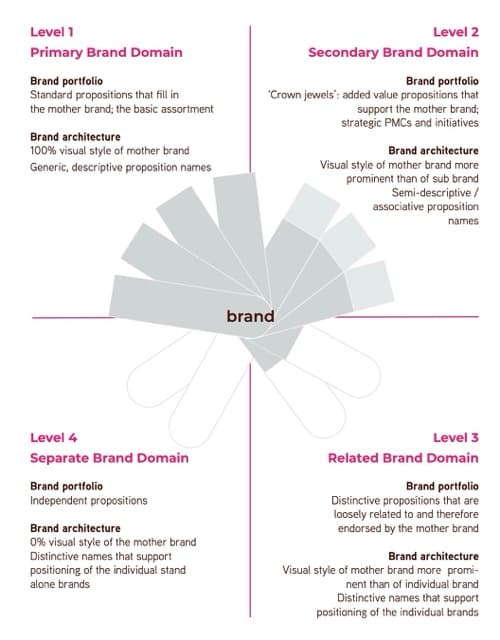
Figure 1. The Brand Fan, simplified: the Brand Heart feeds the mother, the mother carries the sub- and endorsed brands. A free-standing brand exists by exception only.
Three classic architectures, now seen through the fan - a typology systematically described by David Aaker (UC Berkeley Haas) and Erich Joachimsthaler in 2000. The Brand Fan deliberately builds on that lineage: it translates Aaker's architecture spectrum, from Branded House to House of Brands, and Jean-Noël Kapferer's strategic work on brand identity (HEC Paris) into one emotional map. Where Aaker structures the architecture and Kapferer disciplines the identity behind it, the Brand Fan adds the psychological distance to the Brand Heart that both frameworks imply but rarely make visible.
- Branded House (monolithic). First preference, unless you have a real reason to deviate. Think TNO, IKEA, Google.
- Endorsed Brands. The mother confirms, the sub-brands perform. Santeon, Nestlé sub-lines, Microsoft product families.
- House of Brands. The mother is largely invisible, sub-brands stand alone. Procter & Gamble historically, and parts of the LVMH portfolio (though LVMH is increasingly leaning on the group brand for talent, ESG and the investor narrative). In 2026, this form is under genuine legal pressure thanks to transparency requirements.
Brands drifting too far from the axis are repositioned or divested. Not out of anger, out of hygiene. A portfolio is only healthy if you can cut a brand from it without guilt.
When to let a brand go
- When fewer than, say, 10% of the target audience can spontaneously associate the brand with its category.
- When the drive cocktail clashes with the mother's, and nobody is willing to fix it.
- When the margin hasn't justified the marketing budget for three years running.
Retiring a brand is rarely a fun decision. But a clean retirement is more humane, and almost always cheaper, than a brand slowly fading into indifference.
Ten principles for brand portfolio 2026
The ten principles from the BR-ND People green book. The compass we've been using in boardrooms since 2018; still as relevant in 2026.
- A brand is a means to an end. Your organisation's objectives are the starting point for the brand strategy.
- Commitment from the top. Involving top management, brand owners and other key players is an essential success factor.
- The portfolio follows its own logic. Legal or organisational differences don't grant subsidiaries, business units or departments the 'right' to their own brand.
- Portfolio and architecture: two different questions. At organisation level: number and types of propositions and how they relate. At proposition level: the combination and prominence of verbal and visual brand elements.
- Brand association transfer: what happens in the brain. Associations carry over between brands. The more visible the link, the stronger the transfer.
- One brand, unless… One brand is usually the most efficient, but not always the most effective. What fits depends on the reasons to differentiate propositions from each other and from the mother.
- Strategic determinants: hunting for the 'very good reasons'. A structured internal and external analysis reveals what's relevant and what it means for the portfolio.
- The BR-ND Brand Fan: complexity made simple. The Brand Fan visualises portfolio structure and architecture, and shows which rules apply where.
- BR-ND Portfolio Development: a three-step process. Analysis, creation, implementation. Portfolio management grounded in facts and tangible consequences.
- The rules are set. Now what? Managing, monitoring and adjusting also need their own set-up. With at least a responsible team and a clear procedure.
The legal vice: EU Green Claims Directive
On 27 September 2026, the Empowering Consumers for the Green Transition (ECGT) Directive comes into force. Research by Magali Delmas and Vanessa Burbano (UCLA Anderson) showed back in 2011 how vague environmental claims systematically erode consumer trust; this directive targets precisely that pattern. Words like "green", "eco", "environmentally friendly" and "sustainable" will be off-limits without rigorous, certified evidence. Home-made little logos with a leaf in them? Gone. The irresistible temptation to label something 'climate-neutral' because you bought CO₂ certificates somewhere? Over.
| Date | Milestone | Implication for brands |
|---|---|---|
| 27 March 2026 | National legislation deadline | Legal frameworks final per member state |
| 27 September 2026 | ECGT enforcement | Fines of at least 4% of turnover for cross-border infringements; lower thresholds may apply nationally |
| Ongoing | End of offsetting claims | No 'climate-neutral' based on offsets |
What ECGT actually changes in your portfolio
- Kill the 'eco range'. A great many sub-labels launched in recent years as 'sustainable variants' are no longer viable without heavy certification. Either you back them up with rock-solid evidence, or you take them off the shelf. Nothing in between.
- Centralise the claim infrastructure. The mother carries the evidence (LCA analyses, independent audits, certificates) and the sub-brands may 'borrow' those claims. That isn't merely compliance; it's branding too: the mother becomes visibly the bearer of integrity.
- Update your packaging. Not just digital, physical too. Every icon not tied to a recognised scheme comes off.
- Train your sales organisation. B2B sales decks are stuffed with unfounded sustainability claims; under ECGT, that counts as misleading too.
The winners? Organisations where the mother carries the evidence and the sub-brands borrow the claim. Under Mother's Umbrella gains a legal layer: protection against your own PR.
B2B brand strategy is emotion: the 95:5 rule
For a long time, brand strategy in B2B was treated as the helpful sidekick of sales. A PowerPoint, a logo, a banner at the trade show. In 2026 that view has shifted for good, partly thanks to the work of the Ehrenberg-Bass Institute and the application of 23plusone in business contexts.
B2B buyers are also people. And precisely because their risks and egos run higher, emotional branding often works even harder there than in B2C. A wrong choice can cost a career; a brand that delivers 'safety' and 'ambition' hands that buyer the emotional cover they need to convince the C-suite.
The 95:5 rule, explained
Formulated by John Dawes at the Ehrenberg-Bass Institute (University of South Australia, 2021), the 95:5 rule says that at any given moment only around 5% of business buyers are actively in market. The other 95% are future buyers you have to reach now, while they're not yet looking. Anyone aiming their entire brand budget at that 5% (via performance marketing and bottom-of-funnel tactics) is systematically sawing through the branch they're sitting on. The exact ratio varies by category and buying cycle, but the underlying point is robust: short-term activation without long-term brand-building shrinks the future buyer pool.
The laws of B2B brands in 2026
- Mental availability. Be top-of-mind at the right Category Entry Points (CEPs); the moments when a need surfaces. "When we want to scale…", "when we need compliance…", "when the CFO gets twitchy…".
- Physical availability. Make sure you're findable and buyable, digitally and physically. A perfect brand nobody can reach is an expensive piece of art.
- Distinctive Brand Assets. Recognisable, distinctive brand assets (colour, shape, voice, typography, rhythm) that signal you without a logo.
- Creative courage. In The B2B Effectiveness Code (Hurman & Field, LinkedIn B2B Institute & WARC, 2021), roughly three-quarters of B2B ads score at the bottom of System1's emotional rating scale, meaning they generate barely any long-term brand effect. Translation: most B2B work is forgettable, and forgettable is expensive. Daring isn't a creative luxury here; it's ROI.
- Consistency over time. B2B buying cycles run 6 to 18 months. A brand reinvented every quarter is forgotten well within that window.
Why purpose in B2B isn't a nice-to-have
Companies like ServiceNow, Salesforce, Adobe and SAP show that emotionally charged B2B brands can command valuations their 'rational' competitors simply can't reach. Not because their technology is necessarily better (it helps), but because their story sticks. They build networks and shared meaning, not just tooling.
Problem-solving capitalism: the new purpose
Colin Mayer has put it sharply: companies making money from problems they cause themselves are a dying breed. Not from moral severity, from economic reality. The Brand Heart of 2026 internalises the cost of its own impact. That has three portfolio consequences:
- Problem-led portfolio. Every sub-brand demonstrably contributes to the mission. If it doesn't, it's overhead with a logo on top.
- Ethical profit definition. Profit is what's left after social and ecological costs. Externalities are no longer external in 2026.
- Capital follows soul. Investors are increasingly looking at the brand's drives, not just EBITDA. Impact has become a source of multiple expansion. Peer-reviewed work by Gartenberg, Prat & Serafeim (2019, Organization Science) (Wharton / Columbia / HBS) confirms that companies with clearly articulated purpose deliver significantly better financial outcomes.
The new compass: from "why" to "which problem"
Simon Sinek's start with why was a revolution in 2009. In 2026, 'why' is no longer enough; it's the entry ticket. The question that actually matters is: which problem do you solve, for whom, measurably, and with what evidence? Purpose without a problem is a poster. A problem without drives is a spreadsheet. You need both.
A Brand Heart that genuinely lives this connects:
- Problem. A concrete societal or human problem we want to reduce.
- Drives. The emotional engine that moves us and our customers.
- Evidence. Measurable impact, externally verifiable, publicly transparent.
That last point is no longer up for negotiation. Otherwise you collide with ECGT and with your own employees.
In practice: four brands that get it
Van Vulpen: culture as underground infrastructure
At infrastructure builder Van Vulpen, culture doesn't hang on the wall, it sits in the trench. By translating 23plusone drives into concrete behaviour on the construction site, the brand has become immune to the usual growing pains. Diggers and directors speak the same language, and that isn't poetry; it's productivity. New employees can tell within weeks whether they fit, longer-serving employees know exactly why they stay.
Santeon: seven hospitals, one heart
Seven competing hospitals, one endorsed brand. Santeon works because the mother stands for value-driven care, while the local hospitals keep their familiar names. Sharing data, sharing best practice, holding on to the patient relationship. Collaborating without merging is an art. And a textbook illustration of the Brand Fan in practice: the axis is shared quality, the sides are local identity.
TNO: monolithic and dead serious
TNO does everything under one flag, from responsible AI to the energy transition. Precisely because the expertise is so broad, the parent umbrella is the glue. One brand, maximum collective credibility. A researcher working in a niche field automatically borrows the entire institute as reference. No accident, that; architecture.
Province of South Holland: a public brand with a private nerve
Government organisations are entitled to a Brand Heart too. For a provincial government's brand, everything turns on the tension between neutrality (we serve everyone) and direction (we have to make choices about housing, energy and mobility). The 23plusone method makes visible which drives the executive board, the civil service and residents share. What you find there isn't a logo, but a shared language for working through thorny policy files.
Naming and architecture in the AI era
In 2026, part of the brand experience is no longer determined by the customer, but by the algorithm serving the customer first. Generative AI, search, comparison sites and assistants filter, summarise and cite. A brand portfolio therefore has to be machine-readable and human-feelable.
Three practical consequences:
- Names must be unique and unambiguous. Ambiguous names (such as product names that double up as ordinary words) confuse models. That works against your ranking.
- Relationships must be explicit. 'From the same makers as…' on your website, in your metadata, in your structured data. That way an LLM can name your family without guessing.
- Consistency across channels. AI models compare what you say on your own site with what others say about you. Divergence is a risk; consistency is a bonus.
The Brand Heart is the anchor here: when every piece of communication starts from the same core pillars, every channel sounds like the same brand. Pleasant for humans, essential for machines.
Measuring: KPIs that actually matter in 2026
Brand management without measurement is wishful thinking. But most brand KPIs are rubbish: brand awareness measuring everything and nothing, Net Promoter Score divorced from context, recall scores correlating more reliably with media spend than with meaning. So what does work?
- Brand Appeal (23plusone Emotive Scan). The attractiveness of your brand in relation to your drives, compared with competitors.
- Mental Availability. How often you're spontaneously named at relevant Category Entry Points.
- Distinctive Asset Recognition. Do people recognise your colour, shape, voice, without seeing the logo?
- Cultural Fit Score. The degree to which employees recognise themselves in the stated drives. The best leading indicator of customer satisfaction in existence; and the one most boardrooms still refuse to look at.
- Purpose Proof. Measurable contribution to the problem you claim to solve.
Pick three to five simple KPIs, measure them annually, and publish the trends internally. Not to hold people accountable, to keep direction. A KPI in a drawer is a hobby; a KPI on the wall is a compass.
Last updated: April 2026
Five steps to a sharper portfolio
- Baseline. Run a Brand Scan among employees and customers. Where's the gap between how you intend to come across and how you actually come across?
- Establish the Trinity. Capture the essence in three to five pillars. Not fifteen. Pillars everyone understands, can pronounce and can recognise in colleagues' behaviour.
- Portfolio audit. Hold every brand against the One Brand, Unless… yardstick, ECGT, and the mother's drive cocktail. Mark what stays, what changes, what merges, and what quietly retires with dignity.
- Design the architecture. Draw the Brand Fan and decide each brand's distance from the mother. Make every brand's role explicit in a single sentence; if you can't write that sentence, it doesn't have a role.
- Embed in behaviour. Translate this into HR (recruitment, development), R&D (product choices), customer process (service, sales), legal (claims) and external communication. Otherwise it stays a deck quietly gathering dust.
Pitfalls: where brand portfolios get stuck
- The 'one more brand' reflex. Every new product gets a name, every new name gets a mini-campaign, every mini-campaign fragments attention. The biggest win is often simply to stop starting.
- Rebrand as escape hatch. When the organisation is stuck, the brand identity tends to be the thing that gets changed. That's symptom management with better typography. A rebrand without culture work is a plaster on a broken leg.
- Copy-paste from the last gig. Brand managers bring their previous brand with them. That rarely works; every mother is unique.
- Holding too tight. The fan has to be flexible. Rigid portfolio rules make the organisation slower than the market.
- Outsourcing too much to agencies. External partners bring fresh perspective, but the brand stays the property of the organisation. Not of the agency that happens to be along for the ride for three years.
The 2026 portfolio checklist: six questions for the boardroom
If you only have ten minutes with the executive team, run this checklist. It's built from the ten principles, One Brand, Unless…, ECGT and the 95:5 rule, distilled into questions you can answer with a yes, a no or an honest 'we don't know'; the last one being the most useful answer of the three.
- Can every brand in your portfolio name one drive cocktail it activates better than its competitors?
- Does each sub-brand demonstrably benefit the mother, and the mother demonstrably benefit each sub-brand?
- Can you substantiate every sustainability claim under ECGT today, not 'soon'?
- Are your top three Category Entry Points covered by consistent, distinctive brand assets?
- Is your culture articulated clearly enough that a new hire can describe it within their first month?
- Would you launch each brand again, today, knowing what you now know? If not, why is it still in the portfolio?
A portfolio that earns six honest 'yeses' is rare. Two or three is normal. Zero is a wake-up call.
Frequently asked questions
What is the core of 23plusone?
23plusone measures 24 universal emotional drives (across five domains: Safety, Self-development, Ambition, Vitality, Attraction) and shows which 'cocktail' makes a brand attractive. It's a scientifically grounded method, applied in more than 25 countries and to hundreds of brands.
When do you deviate from One Brand, Unless…?
Only with conflicting drives, extreme market distance, necessary risk isolation, a planned sale, or conflicting distribution channels. All other reasons usually turn out to be internal politics in disguise.
What does the EU Green Claims Directive actually change?
From 27 September 2026, the Empowering Consumers Directive (EmpCo, 2024/825) bans vague sustainability claims without certified substantiation, blacklists 'climate-neutral' claims based on offsetting, and prohibits non-recognised eco-labels. Penalties are set per member state, with a minimum of 4% of annual turnover for serious cross-border infringements. The separate Green Claims Directive, which would add detailed substantiation rules, is still in the EU legislative pipeline and not yet adopted at the time of writing. Centralising claims at the parent brand is the smartest portfolio response either way.
Why is emotional branding so important in B2B?
Because B2B decision-makers carry higher personal risk, and because 95% of the market isn't in buying mode. Mental availability is built with emotion, not feature lists. Brands that resonate emotionally shorten sales cycles and lift price willingness.
What is the Brand Fan, in one sentence?
A visual model that arranges brands by their psychological proximity to the Brand Heart, so you can see which brands belong together and which are drifting out of the fan altogether.
How often should I recalibrate my portfolio?
A full recalibration fits a strategic cycle of three to five years. A light check (Brand Scan, Brand Fan update) fits an annual cadence, alongside the planning & control cycle. Anything shorter is fashion; anything longer is denial.
Is a rebrand the answer for a weak brand?
Rarely. A rebrand is a signal, not a solution. If culture, product or drives aren't aligned, a new logo only makes the problem more visible.
How do you measure whether a Brand Heart works?
By measuring three things in parallel: cultural fit among employees, appeal among customers, and purpose proof through impact data. When all three move in the same direction, it works.
What is AI's role in brand strategy?
AI is both a channel (generative search engines, assistants) and a tool (scan, analysis, personalisation). Your brand architecture has to be readable for machines and feelable for humans. Consistency is the key; machines read your brand more quickly than humans do, so make sure there's something worth reading.
How hard should a sub-brand be pushed?
That depends on its position in the Brand Fan. Close to the mother? Subtle nuance, modest investment. Further out? Then it needs its own story, and therefore its own budget. Half-heartedly pushing sub-brands is the most expensive option of the lot.
Conclusion: brand strategy as moral leadership
Brand management in 2026 is no longer a cosmetic exercise. It's the meeting point of psychology, sociology, ethics and, yes, plain craft. One Brand, Unless… isn't an efficiency trick; it's a statement of integrity. The Brand Fan isn't a picture; it's a compass. 23plusone isn't a method for marketers; it's a shared language for the entire organisation.
The more transparent the world becomes, the more sharply brands are judged on what they actually do. The winners have something to say and something to show. Brands that not only solve the customer's problem but also face the cost of their own impact. Brands that know their mother, sisters and cousins by name and by role. Brands that take as much pleasure in setting a standard as in launching a product.
People aren't looking for more products. They're looking for more happiness, more safety and more meaning. Brands that understand this don't build campaigns, they build worlds of meaning. And those worlds attract talent, customers and capital.
The best brands of 2026 won't be measured by their share of voice, but by their share of meaning. A harder number to report, perhaps; an easier one to be proud of.
Read also
Want to dig deeper? These articles, propositions and client stories sit naturally next to this piece.
Our propositions
- Brand strategy, positioning & portfolio: the meeting point of 23plusone, the Brand Fan and One Brand, Unless….
- Culture development & employer branding: brand and culture as one system, not two departments.
- Brand research & emotive dynamics: measuring what really moves people, beneath the surface of language.
Client stories
Other What's new articles
Scientific sources
A longread without sources is a TED talk without slides. The fifteen rigorous sources below form the scientific bedrock of this whitepaper: Kim Cramer's PhD thesis, peer-reviewed work on brand architecture, brand growth, emotional decision-making, culture and regulation. Universities on the line-up: University of Amsterdam, UC Berkeley Haas, Tuck Dartmouth, Wharton, Columbia, Harvard Business School, MIT Sloan, Saïd Business School (Oxford), Princeton, USC, Hebrew University of Jerusalem, University of South Australia and UCLA Anderson.
- Aaker, D.A. & Joachimsthaler, E. (2000). The brand relationship spectrum: The key to the brand architecture challenge. California Management Review, 42(4), 8-23. UC Berkeley Haas.
- Cramer, K.V.B. (2005). Onder moeders paraplu? Determinanten en effecten van merkportfoliostrategieën. PhD thesis, University of Amsterdam / SWOCC.
- Damasio, A.R. (1994). Descartes' Error: Emotion, Reason, and the Human Brain. Putnam. University of Iowa / University of Southern California.
- Dawes, J. (2021). Advertising effectiveness and the 95-5 rule: Most B2B buyers are not in-market right now. Ehrenberg-Bass Institute, University of South Australia.
- Delmas, M.A. & Burbano, V.C. (2011). The drivers of greenwashing. California Management Review, 54(1), 64-87. UCLA Anderson.
- Edmondson, A. (1999). Psychological safety and learning behavior in work teams. Administrative Science Quarterly, 44(2), 350-383. Harvard Business School.
- European Commission (2024). Directive (EU) 2024/825 - Empowering Consumers for the Green Transition (ECGT). Primary source.
- Gartenberg, C., Prat, A. & Serafeim, G. (2019). Corporate Purpose and Financial Performance. Organization Science, 30(1), 1-18. Wharton / Columbia / Harvard Business School.
- Kahneman, D. (2011). Thinking, Fast and Slow. Farrar, Straus and Giroux. Princeton University, Nobel Prize 2002.
- Keller, K.L. & Swaminathan, V. (2020). Strategic Brand Management (5th ed.). Pearson. Tuck School of Business, Dartmouth.
- Mayer, C. (2018). Prosperity: Better Business Makes the Greater Good. Oxford University Press. Saïd Business School, University of Oxford.
- Park, C.W., Jaworski, B.J. & MacInnis, D.J. (1986). Strategic Brand Concept-Image Management. Journal of Marketing, 50(4), 135-145.
- Romaniuk, J. & Sharp, B. (2022). How Brands Grow, Part 2 (revised ed.). Oxford University Press. Ehrenberg-Bass Institute, University of South Australia.
- Schein, E.H. (2010). Organizational Culture and Leadership (4th ed.). Jossey-Bass. MIT Sloan School of Management.
- Schwartz, S.H. (1992). Universals in the content and structure of values: Theoretical advances and empirical tests in 20 countries. Advances in Experimental Social Psychology, 25, 1-65. Hebrew University of Jerusalem.
Dive deeper into brand portfolio
Want to follow BR-ND People's brand portfolio thinking from end to end? These pieces form one line:
Our service proposition: brand strategy, positioning & portfolio.
Edition history
This publication is not positioned as an update of earlier editions; it's a standalone whitepaper that starts from the same line of thinking.
About the authors
Kim Cramer PhD earned her doctorate at the University of Amsterdam on brand portfolio strategy (Under Mother's Umbrella, 2005), is co-founder of BR-ND People and co-inventor of 23plusone. She bridges science and practice in brands, culture and transformation.