Ayu Koene
insights
26-05-2026
Article: Brand architecture in the AI era
A practical Brand Fan comparison of Anthropic and OpenAI: how BR-ND People reads AI-era brand architecture through Aaker, Kapferer and One Brand, Unless…
Brand architecture in the AI era
AI makes brand architecture unusually visible. These companies are not just naming products; they are deciding where trust should sit, where product energy should build, and where distance is needed so partners, developers or public institutions are willing to adopt the technology.
The Brand Fan
BR-ND People’s Brand Fan maps how close or far products, initiatives and partnerships sit from the mother brand.
At the centre is the Brand Heart: the organisation’s core promise and source of trust. Around it, the fan moves from close to distant:
- Q1 · Core brand system — mother-branded identity, research, infrastructure and trust layers.
- Q2 · Flagship propositions — strategic products that carry the brand forward.
- Q3 · Powered or embedded surfaces — places where the brand is experienced inside someone else’s context.
- Q4 · Independent or open initiatives — systems that need more distance because openness, neutrality or shared ownership matters.
The useful question is simple: does this proposition gain value by being closer to the mother brand, or by standing further away?
This builds directly on established theory. David Aaker's brand architecture spectrum (Branded House to House of Brands) and Jean-Noël Kapferer's strategic work on brand identity (HEC Paris) give the vocabulary; the Brand Fan adds the emotional distance to the Brand Heart that makes those choices visible in the AI era.
Anthropic: the mother brand vouches, Claude sells
Anthropic keeps the division of labour fairly clean. The mother brand carries institutional trust: safety, research, responsibility and public benefit. The product energy sits mostly under Claude.
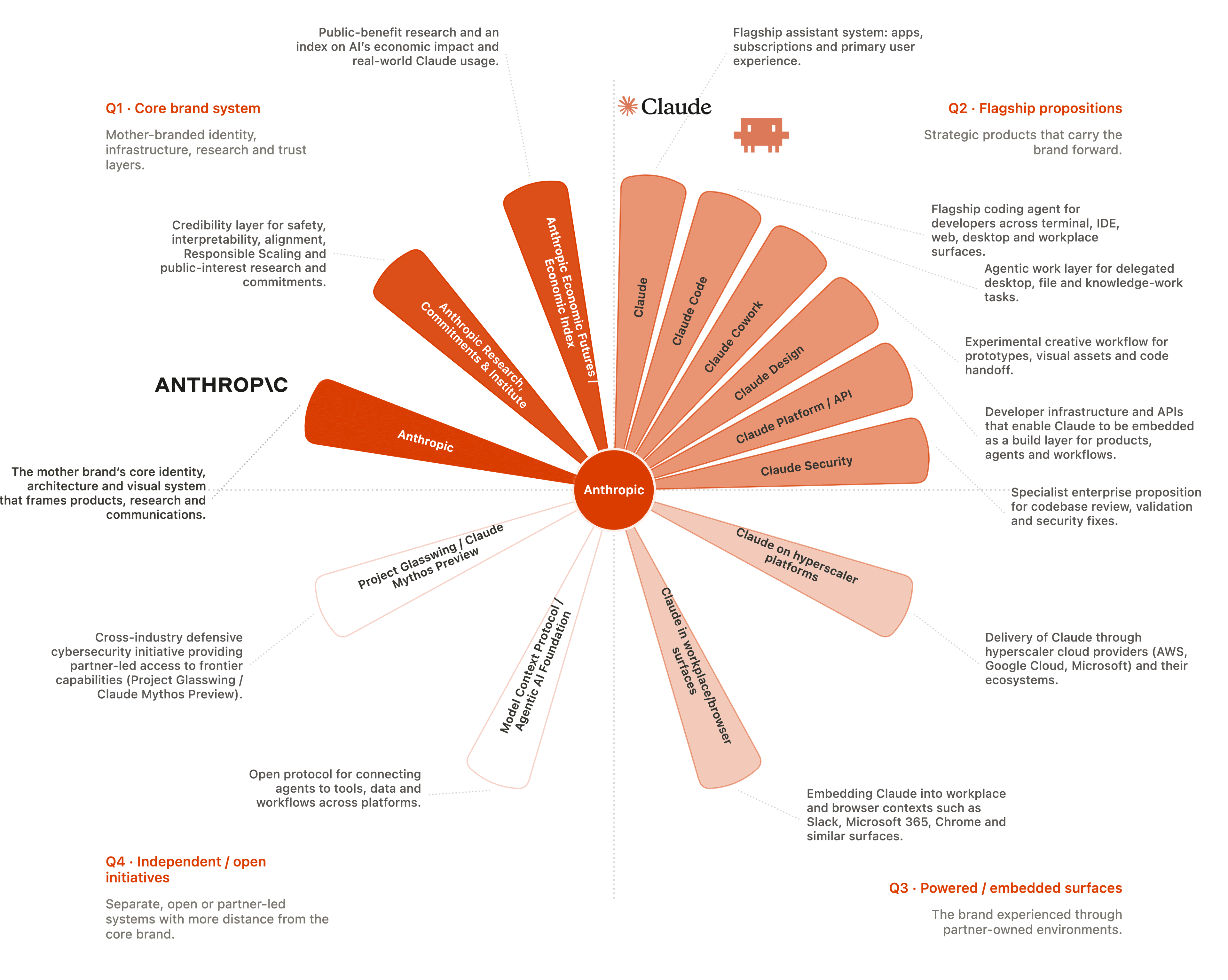
In Brand Fan terms, Anthropic sits close to the centre for research, commitments and policy work. Claude becomes the flagship proposition: Claude, Claude Code, the API platform and related product surfaces. When Claude appears inside AWS, Google, Microsoft or Slack environments, it moves into partner-owned contexts. Open initiatives such as Model Context Protocol need more distance because adoption depends on ecosystem trust, not just Anthropic ownership.
The result is a single-headed concentration. Anthropic vouches. Claude does the selling. That makes the system easy to read: one institutional brand, one product brand, one clear handoff.
OpenAI: the mother brand sells and vouches
OpenAI uses the company name more actively. It appears across developer infrastructure, government propositions, research, safety, public-benefit work and partnerships. The name OpenAI is not only behind the products; it is part of what is being sold.
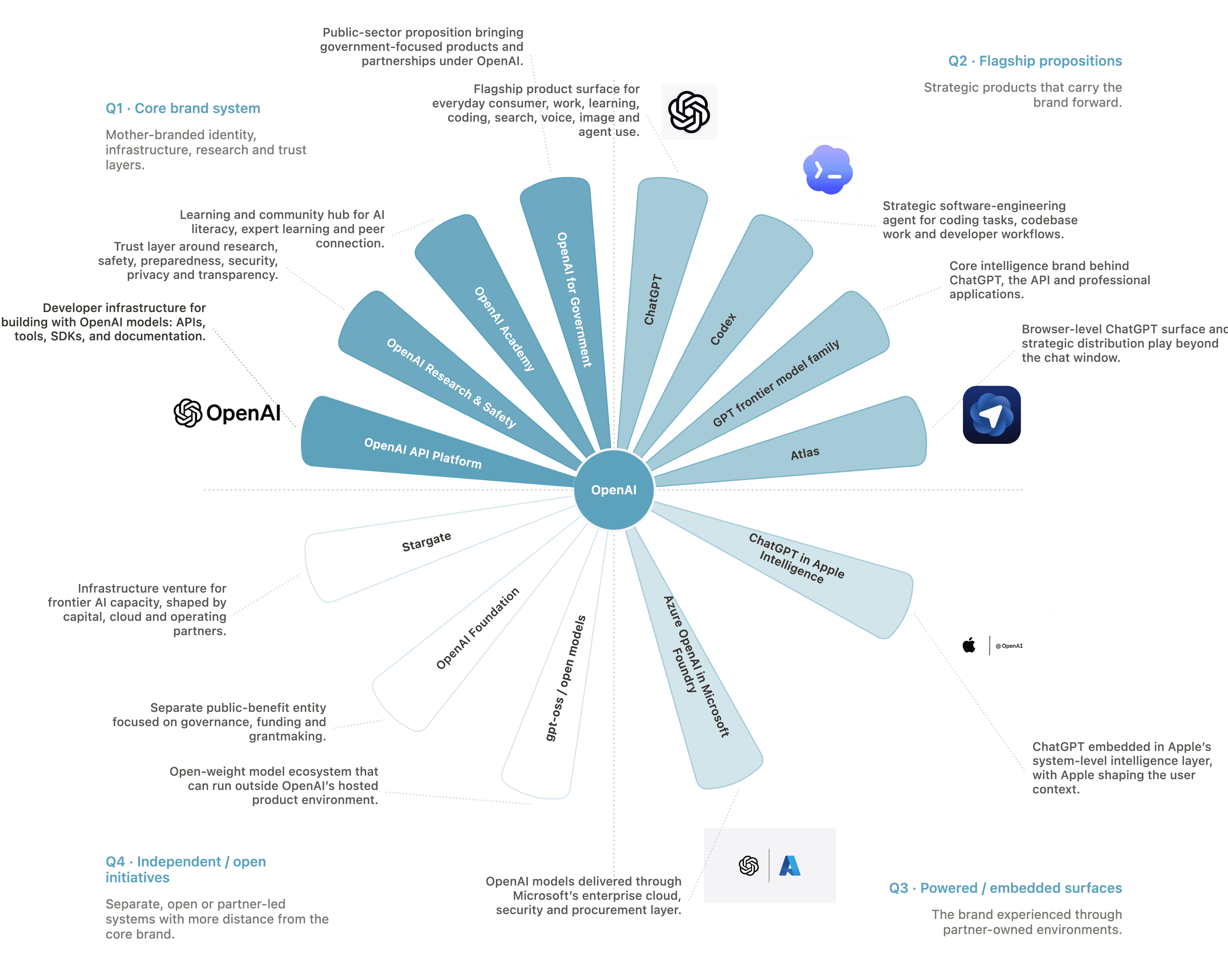
ChatGPT, GPT, Codex and Atlas each carry product energy, but the OpenAI name remains close and visible. Partnerships such as ChatGPT in Apple Intelligence or Azure OpenAI add another layer: the user may meet OpenAI’s technology inside someone else’s world. More distant initiatives, such as open-weight models, foundations or infrastructure projects, create space where openness or governance matters.
The result is a two-headed concentration. OpenAI is the trust umbrella, while ChatGPT is also a major product brand in its own right. That creates reach and recognition, but also more to explain.
The comparison
| Anthropic | OpenAI | |
|---|---|---|
| Mother brand role | Primarily vouches | Sells and vouches |
| Main product energy | Concentrated under Claude | Shared between OpenAI, ChatGPT, GPT, Codex and Atlas |
| Architecture type | Single-headed concentration | Two-headed concentration |
| Strength | Clarity and efficient product memory | Visibility and broad mother-brand recognition |
| Risk | Claude has to stretch across many jobs | More icons to explain and maintain |
What AI adds: ecosystem neutrality
AI adds a newer reason to create distance from the mother brand.
Some initiatives only work if others believe they can serve the ecosystem, not just the company behind them. Open standards, open-weight models, public-benefit vehicles, safety coalitions and cross-industry protocols often need adoption from competitors, regulators or open communities.
In those cases, closeness can reduce trust. Distance becomes useful.
A quick portfolio test
Use the Anthropic–OpenAI comparison as a practical check:
- What job is your mother brand doing? Is it selling, vouching, or trying to do both?
- How many flagship propositions can you afford? Every extra product brand needs memory, meaning and maintenance.
- Where does a partner own the context? If the user meets you inside someone else’s platform, you may need an endorsed or embedded logic.
- Where would ownership reduce trust? If a proposition gains value by being neutral, give it distance on purpose.
- Can an outsider read the system quickly? If people need a diagram before they understand the portfolio, the architecture is probably doing too much.
Conclusion
Anthropic and OpenAI both follow One Brand, Unless…, but they make different choices.
Anthropic concentrates around Claude, while the mother brand protects trust from a slight distance. OpenAI concentrates around a strong mother brand that also sells.
Neither model is automatically better. The right choice depends on what the mother brand needs to do, how many product names the organisation can support, and where distance creates more value than control.
For most portfolios, the lesson is not to copy either brand. It is to make the same decision deliberately: one brand wherever possible, distance only where it earns its keep.
Read also
Our service proposition: brand strategy, positioning & portfolio.
Last updated: May 2026