Team BR-ND People
insights
27-04-2026
Article: Your brand is not a logo. Your brand is a construct.
Brand identity is more than a logo, it's a construct. Discover the science behind Distinctive Brand Assets, AI as co-creator, and what truly sticks in your audience's mind.
Your brand is not a logo. Your brand is a construct.
Let's set one thing straight: a logo is a recognition mark. A brand is something else entirely. A brand is a mental construct in the minds of people, built up from years of cues, stories and repeated exposure. The difference isn't semantic; it's the difference between a house and a wall painting of a house. Lovely to look at, you just can't live in it.
At BR-ND People we study the house, not the wall painting. What fascinates us: the building methods change at speed; the neural laws of the human brain do not.
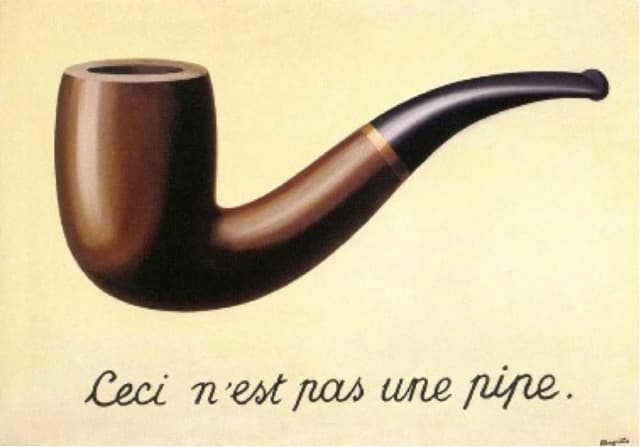
Image: René Magritte
- A brand is not a logo, but a mental construct in the minds of people, built from consistent cues.
- Distinctive Brand Assets are the sensory shortcuts (colour, shape, sound, language) that activate that construct in some milliseconds.
- Consistency beats personalisation: shifting identities erode recognition, and with it brand value.
- AI accelerates production, not strategy: the blueprint stays human work.
- Logos age. Constructs endure.
The story before the pixel
Before a designer draws a line or a copywriter types a word, one thing has to be in place: a brand story. Not as a formality; as the foundation.
Why? Because your brain never looks at what it sees. It asks why it's there.
Research on Brand Congruence (Misra & Beatty, 1990) shows that the moment visual cues stop matching the underlying brand personality, cognitive dissonance kicks in: an unconscious alarm bell that erodes trust. Narrative Transportation Theory (Green & Brock, 2000) shows that a strong story literally carries its readers along. Attention deepens, resistance melts, the message sticks. A clear Tone of Voice (TOV) gives that story its rhythm.
No story? Then assets are cosmetic noise. Pretty noise. But noise.
How do you build Distinctive Brand Assets that stick?
Byron Sharp (2010) and his colleagues at the Ehrenberg-Bass Institute named them Distinctive Brand Assets: the sensory shortcuts that lead the brain straight to your brand. Not design tricks. Neurobiology.
Paivio's (1986) Dual Coding Theory explains why: our brain processes verbal and visual information through separate channels. When the two march in step, a brand becomes literally unforgettable. Phua et al. (2026) tracked 1,162 assets over nine years and 21 categories in four countries and confirmed what Sharp had argued: consistent use over time is the strongest predictor of both Fame and Uniqueness. Industry research from Ipsos (2024) shows that campaigns actively deploying Distinctive Brand Assets perform on average 62% better. Not peer-reviewed, but consistent with the academic literature. In practice it comes down to two layers:
- Visual expression: colour, typography, visual language.
- Verbal expression: the TOV and the terminology that's instantly recognisable, even when the logo falls off.
For Culturis, a cultural institution that connects community and cultural programming, Kiki Hartmann developed a visual system around one recognisable anchor, a bold colour palette and typography the community itself can pick up. Not a design system to file in a drawer. A system that gets used every day.
Three eras, one law
The assets are the load-bearing walls of your communication. They stand, regardless of the style period in vogue. How we build and renovate them does change.
The analogue past: the brand as a construct of stone
Before the internet, the brand construct was literally static and physical. Designers worked with type-setting machines and Pantone swatches. A brand was a building of stone: once set, it stood for decades. Logos were designed for a lifespan of twenty years. Not out of vision, but out of material logic. Rebuilding cost more than building.
The digital present: the house becomes modular
The internet made the brand construct fluid. CMYK gave way to RGB; responsive design became the standard. Vector software made everything scalable. Motion branding and sonic identities arrived as new floors on the same foundation. The psychological principle underneath: Processing Fluency (Reber, Schwarz & Winkielman, 2004). The easier the brain processes an asset, the more positive the judgement. Aesthetic ease isn't a luxury; it's strategy. See how Kiki Hartmann translates that thesis into a full Brand Culture Manual for Thorizon, usable from Amsterdam to Sydney.
The future: the AI master builder takes a seat at the table
We're in the middle of the AI explosion. Technology is no longer a tool; it's a partner. AI generates thousands of variations in seconds, all strictly within brand guidelines. Research by Kang & Shen (2024), presented at IASDR, compares six cases with and without GenAI and concludes: GenAI dramatically accelerates the concept phase and democratises creativity, but human expertise remains indispensable for legal risk, cultural nuance and brand integrity. The shift is fundamental. Your brand story and TOV become your Master Prompt. AI delivers the quantity; the strategic decision of which assets are worth building stays human work. Think of Thorizon: pioneers in circular nuclear energy who needed a brand that feels as radically renewing as the technology itself. For brands like that, the strategic blueprint is no afterthought. It's the difference between winning trust and losing it before the first reactor even spins.
The chameleon trap
Now that AI can serve every user a personalised experience, a concrete temptation appears for every brand team: tailor everything per segment, per platform, per user. Let the AI fill in the identity dynamically, depending on who's looking. Why hold on to a fixed colour if the machine can optimise it for each individual?
The answer is structural. You can change the cladding. You can't change the load-bearing frame. Anyone who tries doesn't have a flexible brand; they have an unstable building with a lot of different front doors.
If everyone sees a different brand, you lose Brand Cohesion. Brands are social signals; we choose them partly because we know what they mean to others. On top of that, the brain is an energy-saving machine. Shifting visual cues force it to relearn the sender every time. That tears down mental availability.
The science is clear. The Mere Exposure Effect (Zajonc, 1968) shows that we develop a preference for things simply because we're consistently exposed to them. Recognisability beats total personalisation. Bali, Anesbury, Phua & Sharp (2024) add an AI-driven insight: suggestive assets that translate the category too literally score systematically lower on both Fame and Uniqueness than abstract, unexpected choices. So the surprise element isn't a design whim. It's a measurable strategic variable.
The rule for the future: use AI for hyper-personalised messages; keep your identity unshakeable.
The economics of brand creation are changing
| Aspect | Analogue (past) | Digital (present) | AI (future) |
|---|---|---|---|
| Development time | Months (handwork) | Weeks (software) | Hours (iteration) |
| Cost focus | Production and material | Specialist labour | Strategy and curation |
| Flexibility | Zero (fixed) | Medium (templates) | Hyper-personalised |
For the CFO in the room: as production costs trend toward zero, the value of the strategic blueprint rises, the architectural drawing behind the brand. The Photoshop hours evaporate. Thinking time becomes the real budget. You pay for the reasoning behind why this set of assets works in an overstimulated world.
Take St. Antonius Hospital, a regional healthcare network with multiple locations across the Utrecht region. The challenge wasn't one logo or one campaign; it was making a complex care portfolio legible and recognisable for patients, staff and referrers all at once. The difference isn't in the execution in pixels or templates. It's in the blueprint underneath, deciding which assets work in which context. That architectural drawing returns its value over years.
Building costs fall. The value of the design rises. That's never been any different in architecture, and the same applies here.
The method changes. The impact stays.
Whether you build a brand with a goose quill or with a prompt, the laws of recognisability don't move. The human brain needs just 13 milliseconds to process the meaning of an image, before conscious recognition even occurs (Potter et al., 2014). In that flash, your brand identity has to stand like a house.
The question isn't whether your brand survives those 13 milliseconds. The question is whether the construct behind it is strong enough to keep standing as the tools, the zeitgeist and the technology change again.
A good brand isn't cosmetic. It's structural work. At BR-ND People we engineer brand constructs for cultural institutions, healthcare networks and clean-energy pioneers, from Culturis to St. Antonius Hospital to Thorizon. If you want to know what the construct of your brand looks like, and why some foundations crack while the façade still looks pristine: we'd love to talk.
Frequently asked questions about brand identity
What's the difference between a logo and a brand identity?
A logo is a single visual element. Brand identity is the full system of visual, verbal and behavioural elements that make an organisation recognisable: colour, typography, tone of voice, visual language, sonic identity and the stories beneath them. A logo can change. The construct behind it moves far more slowly.
What are Distinctive Brand Assets?
Distinctive Brand Assets (DBAs) are the sensory shortcuts people associate with a specific brand, even without seeing the brand name. A recognised colour. The rhythm of a jingle. The curve of a packaging design. They're built through consistent repetition and measured by Fame (how quickly people recognise them) and Uniqueness (how exclusively they tie to the brand). Get those two right, and your brand barely needs the logo at all.
How does AI help in building a strong brand identity?
AI can generate thousands of variations in seconds, all within predefined brand guidelines. That dramatically speeds up the production phase. The strategic blueprint, the choice of which assets are built and why, stays human work. AI is the contractor. The architect decides the design.
Why is consistency so important for brand recognition?
The human brain is an energy-saving machine. It builds mental shortcuts from repeated exposure (Mere Exposure Effect, Zajonc 1968). The more consistently a brand behaves over time and across channels, the less cognitive effort it takes to recognise it, and the more positive the judgement (Processing Fluency, Reber et al. 2004). Consistency isn't a lack of creativity. It's the foundation of brand value.
Scientific references
- Phua, P., et al. (2026). Benchmarking distinctive brand asset performance across categories, countries and time. International Journal of Advertising.
- Bali, L. M., Anesbury, Z. W., Phua, P., & Sharp, B. (2024). How prevalent are suggestive brand names and Distinctive Assets? An AI-human approach. Journal of Consumer Behaviour.
- Kang, B., & Shen, Y. (2024). Brand Identity Design with Generative AI: Between Automation and Authorship. IASDR Proceedings.
- Potter, M. C., et al. (2014). Detecting meaning in RSVP at 13 ms per picture. Attention, Perception, & Psychophysics.
- Paivio, A. (1986). Mental Representations: A Dual Coding Approach. Oxford University Press.
- Reber, R., Schwarz, N., & Winkielman, P. (2004). Processing Fluency and Aesthetic Pleasure. Personality and Social Psychology Review.
- Misra, S., & Beatty, S. E. (1990). Celebrity spokesperson and brand congruence. Journal of Business Research.
- Green, M. C., & Brock, T. C. (2000). The role of transportation in the persuasiveness of public narratives. Journal of Personality and Social Psychology.
- Zajonc, R. B. (1968). Attitudinal effects of mere exposure. Journal of Personality and Social Psychology.
- Huang, M. H., & Rust, R. T. (2021). Engaged to a Robot? The Role of AI in Service. Journal of Service Research.
Further reading. A brand construct rarely stands alone; it moves inside a portfolio of mother brand, sub-brands and endorsements. Read Under mother's umbrella, the doctoral thesis that laid the academic foundation for brand portfolio strategy.
Last updated: April 2026