Alexander Koene
insights
27-05-2026
Article: Work engagement is an outcome, not a lever
Engagement scores give little direction. Quality of motivation does. What a major meta-analysis means for leadership, strategy and internal branding.
Work engagement is an outcome, not a lever
Published 26 May 2026. By Alexander Koene. Reading time: 10 minutes.
Work engagement in one sentence: a positive working state with three traits: energy, dedication, and absorption. What matters in practice isn't how much motivation people carry, but the quality of that motivation.
Key points
- Work engagement is usually measured with a questionnaire (the UWES). It tracks three things: energy, dedication and absorption. In daily practice those three blur into one general mood score.
- A major review by Hakanen and colleagues (2026) summarises twenty years of work engagement research. What's missing: how strong the relationships actually are, and how this fits into a wider story about what really drives people at work.
- A second large recent study, by Hagger and McAnally Star (2026), pulls together almost two hundred studies. The headline: people who work because they want to, perform better, feel better, and leave less often. People who work out of pressure or duty leave faster and burn out more often.
- The biggest effect doesn't come from "I enjoy this", but from "I find this important". Work someone personally values weighs the heaviest.
- A leader who creates room, shows trust, and builds real connection lights the kind of motivation that produces both performance and meaning.
- Internal branding only holds when the motivation inside the company can carry the promise outside. Quality of motivation is the lever; engagement is the read-out.
The ritual that fixes nothing
Anyone who has ever managed a team will recognise it. The employee engagement survey. A table of averages, a few arrows, a slide deck of 'areas for improvement'. Someone says: we need to raise autonomy. Nobody knows what that means tomorrow. In which meeting, in what conversation, on which decision. The score slides into a drawer, and work carries on the way it always did.
Twenty years on, the real question is whether this ritual fixes anything or just keeps itself running. A recent overview by Hakanen and colleagues (2026) promises a synthesis of two decades of work engagement research. What it delivers is a collection. Not a synthesis. And above all: no answer to the only question that matters to a leader. What do I do differently tomorrow?
Work engagement in an awkward mirror
Work engagement was framed in the early 2000s as a positive counterweight to the heavier burnout research. Three dimensions: vigour (energy), dedication (involvement), absorption (being immersed in the work). Measured with the Utrecht Work Engagement Scale. Tidy on paper.
In practice those three dimensions tend to collapse into one underlying score (Lindberg et al., 2025). A team that scores high on vigour usually scores high on dedication and absorption too. Anyone hoping for targeted action per dimension got a general mood thermometer instead. The look of precision without the precision.
On top of that, Hakanen stacks a theoretical jungle: supportive resources at work (jargon: 'job resources'), job demands, personal strengths, leadership styles, social support, feedback, team ownership. All of them, supposedly, contributing to engagement. Sometimes. Sometimes not. Job autonomy, room to make your own choices at work, is one of those resources; except when it makes someone feel abandoned. In that case the same autonomy becomes a stressor.
How strong are all those influences? Not reported. A ranking of what helps most? Not present. The underlying studies on engagement interventions (Knight et al., 2017) showed that roughly half had a measurable effect, 45 per cent had none, and 5 per cent had a negative effect. Programmes designed to lift engagement turned out to be about as predictable as a British summer.
And still organisations come back for more. Because the question stays the same. How do we get our people moving again?
The wrong question
There is an assumption sitting under that question, rarely said out loud. That motivation is something you can press. A button. More autonomy in, more engagement out. It explains why the same menu keeps coming back: ping-pong tables, pulse surveys, psychological safety workshops, mindfulness pilots. Trying things and hoping.
Look at behaviour and a different picture appears. It isn't the amount of motivation that predicts performance, wellbeing, absenteeism and attrition. It's the quality of motivation. That is exactly what a large meta-analysis by Hagger and McAnally Star (2026) makes visible, drawing on nearly two hundred studies.
The building blocks of motivation: self-determination theory as a frame
A comparison. Diamond and graphite are both pure carbon. Same atoms, different structure, opposite behaviour. Diamond is the hardest natural material we know; graphite breaks under your fingertip. Motivation works the same way.
Self-determination theory, the forty-year body of work by Deci and Ryan, says people run on three psychological needs. Autonomy: the sense that you act from yourself. Competence: the sense that you're skilled at what you do. Relatedness: the sense that you belong. Support those three and autonomous motivation forms. You do the work because it's interesting (intrinsic) or because you find it personally worthwhile (identified). Frustrate them and controlled motivation forms. You do the work out of guilt, status, or to keep someone happy.
The numbers from Hagger 2026 point one way. Autonomous motivation lines up with better performance, more wellbeing, and lower attrition. Controlled motivation lines up with attrition and burnout symptoms. Same task, same job description, different quality of motivation, different person. Different outcome.
More importantly: it is identified motivation, not pure "I enjoy this", that shows the largest effect. "I find this work worthwhile, so I do it" beats "I find this fun, so I do it". Good news for anyone who has ever filed a tax return. Work doesn't need to be fun to be nourishing. It needs to fit.
That job resources sometimes work and sometimes don't makes sudden sense in this light. Choice is a support when it feeds the need for autonomy. It becomes a stressor when it feels like being dropped without a compass. Same object, different experience, different outcome (Van den Broeck et al., 2016; DeHaan et al., 2024).
What leaders do differently tomorrow: four behavioural shifts
This is where the conversation turns. If controlled motivation does damage and autonomous motivation feeds the work, the practical question isn't how do we raise the score. The practical question is: in my day-to-day behaviour, am I supporting my people's psychological needs, or frustrating them?
Four concrete shifts that follow from Hagger and McAnally Star (2026) and Slemp et al. (2018):
- From "I'd love your input" to real choice. Supporting autonomy doesn't mean giving people a vote on a decision you've already made. It means putting the genuinely open part on the table, and accepting what comes back. A team that figures out its 'input' keeps coming back as a pre-cooked outcome learns to go quiet within three rounds.
- From "good job" to competence-building feedback. A pat on the shoulder feeds status (controlled). Specific feedback that helps someone do better work next time feeds competence (autonomous). Small difference in effort. Large difference in effect.
- From "we're a team" to connection on the work itself. Relatedness doesn't come from Friday drinks alone. It comes from people seeing how their work fits into something larger than their job, and from colleagues catching them when they fall. That asks for conversations about what the work is actually for, not only what is due this week.
- From "more resources" to "less need frustration". Many organisations stack support: extra coaches, wellbeing budgets, a new app. Often the cheaper move works better. Strip out the procedures that make people feel mistrusted or incompetent. Inside the organisation that costs you something. In behavioural effect it pays off many times over.
Two quadrants on your whiteboard
A practical exercise for teams: put tasks on a whiteboard along two axes. Vertical: am I doing this because it's worthwhile or interesting (autonomous), or because I have to (controlled)? Horizontal: does it give me energy or drain the battery?
Tasks in the top-right feed self-worth, meaning, and stamina. Tasks in the bottom-left predict attrition or burnout symptoms down the line, even when short-term performance climbs under external pressure. The question isn't what to do with those. You redesign the work where you can, you make the importance explicit where that earns its keep, and you cut what no longer matters.
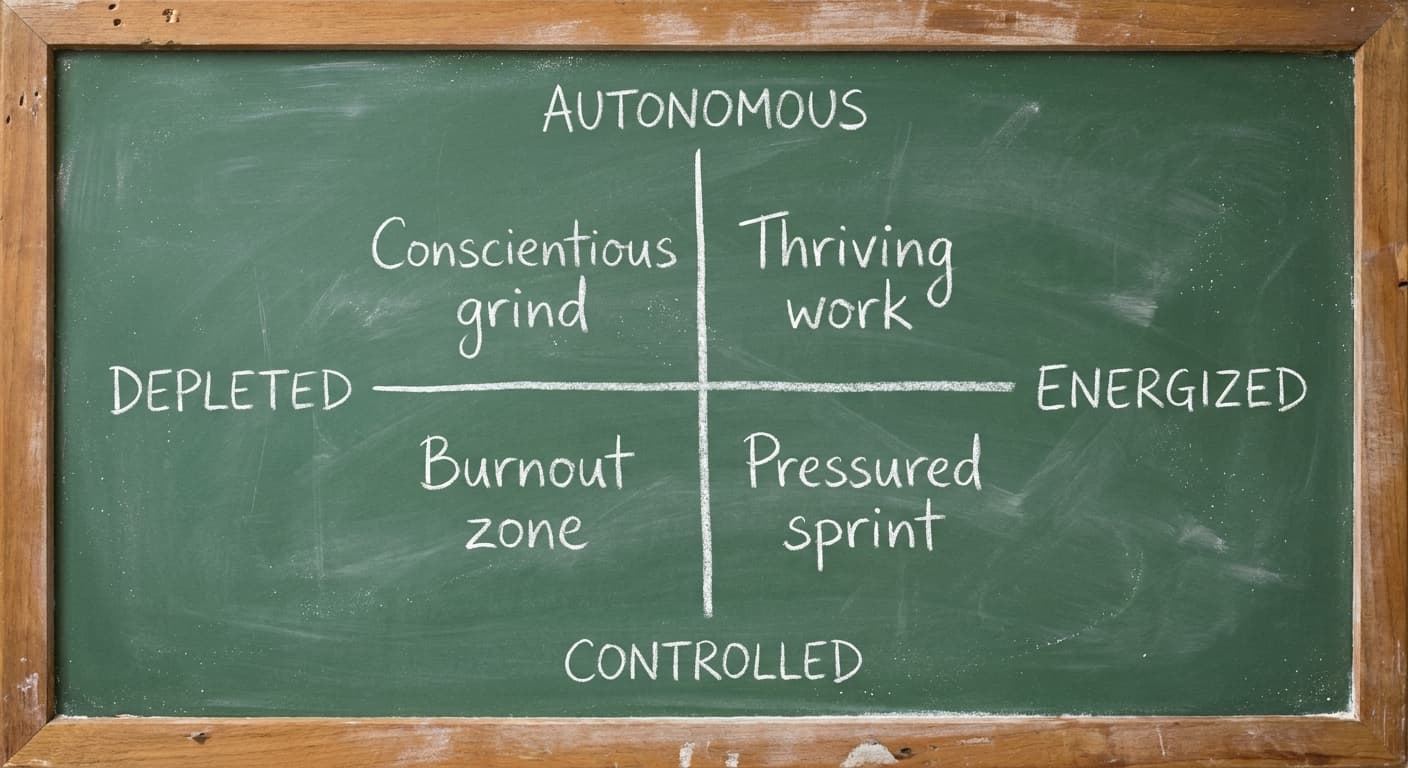
We run this exercise at BR-ND People not only with executive teams. The conversation gets sharper the moment teams themselves put their work on the table. People recognise their own work more precisely than any dashboard pointed at them from above.
Why this is an internal branding question
A brand promise can travel as far as the motivation behind it. If the people doing the daily work act out of obligation, status, or fear of losing their bonus, customers feel exactly that. Polite, correct, lifeless. If those same people act because they find the work worthwhile, customers feel a different kind of contact. Warmer, sharper, more present. Same script, different person on the other side of the counter.
Internal branding earns its keep when it stops being a poster campaign and becomes the deliberate work of bringing the brand promise and the daily experience of employees into one rhythm. The external story holds when the internal motivation can carry it. It collapses when it can't, and no amount of campaign budget repairs that.
Three implications follow for any executive team that treats employer branding as more than recruitment marketing:
- The brand promise sets the bar for leadership behaviour. If your story to the market is about boldness, autonomy, or craft, the daily management style has to match. A brand that promises ownership outside while micromanaging inside teaches everyone, including customers, what to believe.
- Recruitment communication can only attract what the organisation actually offers. A polished careers page that doesn't match the lived experience produces a short stay and a long review on Glassdoor. Sharpen the experience first, then describe it honestly.
- Culture work is brand work. Culture development sits on the same axis as positioning and brand purpose. Treating them as separate projects produces the gap people quietly leave through.
For HR and the executive team there is one more uncomfortable piece. Culture programmes laid on top of a pile of need-frustrating procedures don't produce meaning. They produce cynicism. Employees see exactly when rhetoric is covering a reality nobody in the boardroom wants to touch. If you want internal branding to move, clear the floor first.
The behaviour test, recalibrated
At BR-ND People we try to look at every strategic decision through the same lens. What will people feel, say, choose, and do differently because of this? Motivation science gives that test a sharper edge. The question is no longer 'do people feel more involved'. The question is whether people feel more autonomous, more competent, more connected.
That isn't a philosophical refinement. It is the difference between an organisation where behaviour comes from inside, and one where behaviour is forced until the first person walks out. Between brands people live, and brands people endure. Inside and outside line up: the same drivers that nourish people internally make a brand attractive externally. An executive team that ignores this logic pays twice. In attrition, and in reputation.
Engagement remains a useful self-report. A thermometer. But you don't heat a house with a thermometer. You heat it by changing something in the system that produces the temperature. For work, that system is the quality of motivation. Not how hard, but from where.
What would happen if your next engagement survey didn't end with 'we need to raise autonomy', but with three concrete actions leadership will take differently tomorrow, on which decision, in which meeting, for which employee? That is where the work begins.
Frequently asked questions
What is work engagement, exactly?
Work engagement was defined by Schaufeli and colleagues (2002) as a positive, fulfilling, work-related state of mind with three dimensions: vigour, dedication and absorption. It is usually measured with the Utrecht Work Engagement Scale (UWES). Recent statistical work (Lindberg et al., 2025) shows that structure often collapses into a single underlying score.
What is self-determination theory?
Self-determination theory (SDT), developed by Deci and Ryan, holds that people have three basic psychological needs: autonomy (acting from yourself), competence (being capable in what you do), and relatedness (belonging). When those needs are supported, autonomous motivation forms. When they are frustrated, controlled motivation forms.
What is the difference between autonomous and controlled motivation?
Autonomous motivation means acting from interest (intrinsic motivation) or from personal value (identified regulation). Controlled motivation means acting under pressure: guilt, shame, status, or external obligation. Autonomous motivation lines up with better performance and higher wellbeing; controlled motivation lines up with attrition and burnout symptoms (Hagger et al., 2026).
Which kind of motivation makes the biggest difference at work?
Identified regulation, finding the work personally worthwhile, shows the largest effect in the Hagger et al. (2026) meta-analysis. Intrinsic motivation follows close behind. Work doesn't need to be fun to be nourishing; it needs to fit what someone considers worthwhile.
How does a leader support these needs concretely?
By offering real choice (autonomy), giving specific competence-building feedback (competence), and connecting through content and meaning (relatedness). Often, stripping out need-frustrating procedures works better than stacking on more support.
Why do engagement interventions often fail?
Knight et al. (2017) found that about half of interventions had a statistically significant effect, 45 per cent had none, and 5 per cent had a negative effect. Effects tend to be small. The cause sits in a lack of clarity about which behaviour the programme is meant to change.
Why does work engagement matter for internal branding?
Internal branding is the work of bringing the brand promise and the daily employee experience into one rhythm. A brand can only deliver outside what the motivation inside is capable of carrying. Autonomous motivation produces the behaviour customers actually feel: present, accurate, warm. Controlled motivation produces polite compliance at best and quiet sabotage at worst. Engagement scores are a useful symptom; the underlying lever is the quality of motivation that leadership, strategy and culture together create.
Does self-determination theory replace the Job Demands-Resources model?
No. The Job Demands-Resources model (JD-R), which weighs job demands against job resources, remains useful as an ordering framework. Self-determination theory explains why a given resource works in one context and not in another: only when it actually feeds autonomy, competence or relatedness. SDT functions as an explanatory layer beneath JD-R (DeHaan et al., 2024).
Scientific sources
- DeHaan, C. R., Bradshaw, E. L., Diaz-Castillo, S., Trautman, T. C., Rigby, C. S., & Ryan, R. M. (2024). Energy in the workplace: job demands, job resources, and employees' inner resources as pathways to organizational outcomes. Frontiers in Psychology. https://doi.org/10.3389/fpsyg.2024.1413901
- Hagger, M. S., & McAnally Star, K. (2026). Self-Determination Theory and Workplace Outcomes: A Meta-Analysis. Stress and Health. https://doi.org/10.1002/smi.70151
- Hakanen, J. J., Kaltiainen, J., Bakker, A. B., & Schaufeli, W. B. (2026). Work Engagement: Feeling Happy, Motivated, and Resilient at Work. Annual Review of Organizational Psychology and Organizational Behavior, 13, 23–48.
- Knight, C., Patterson, M., & Dawson, J. (2017). Building work engagement: a systematic review and meta-analysis investigating the effectiveness of work engagement interventions. Journal of Organizational Behavior, 38(6), 792–812.
- Lindberg, M., et al. (2025). Factor structure of the Utrecht Work Engagement Scale in a sample of Danish and Swedish haemodialysis nurses.
- Schaufeli, W. B., Salanova, M., González-Romá, V., & Bakker, A. B. (2002). The measurement of engagement and burnout: a two-sample confirmatory factor analytic approach. Journal of Happiness Studies, 3(1), 71–92.
- Silman, F. (2014). Work-related basic need satisfaction as a predictor of work engagement among academic staff in Turkey. South African Journal of Education, 34(3).
- Slemp, G. R., Kern, M. L., Patrick, K. J., & Ryan, R. M. (2018). Leader autonomy support in the workplace: a meta-analytic review. Motivation and Emotion, 42(5), 706–724.
- Van den Broeck, A., Ferris, D. L., Chang, C.-H., & Rosen, C. C. (2016). A review of self-determination theory's basic psychological needs at work. Journal of Management, 42(5), 1195–1229.
- Wörtler, B., Van Yperen, N. W., & Barelds, D. P. H. (2020). Do individual differences in need strength moderate the relations between psychological need satisfaction and organizational behaviors? Motivation and Emotion, 44, 315–332.
With thanks to Chivo VisieVitaal (25 May 2026) for the sharp summary and recent academic references that informed this piece.