BR-ND People
news
10-06-2026
Article: Money is never neutral - what the Positive Finance Day showed
A report from the eighth Positive Finance Day at Triodos: why money is never neutral, what the Global Justice Report means, and what it asks of brands.
Money is never neutral - what the Positive Finance Day showed
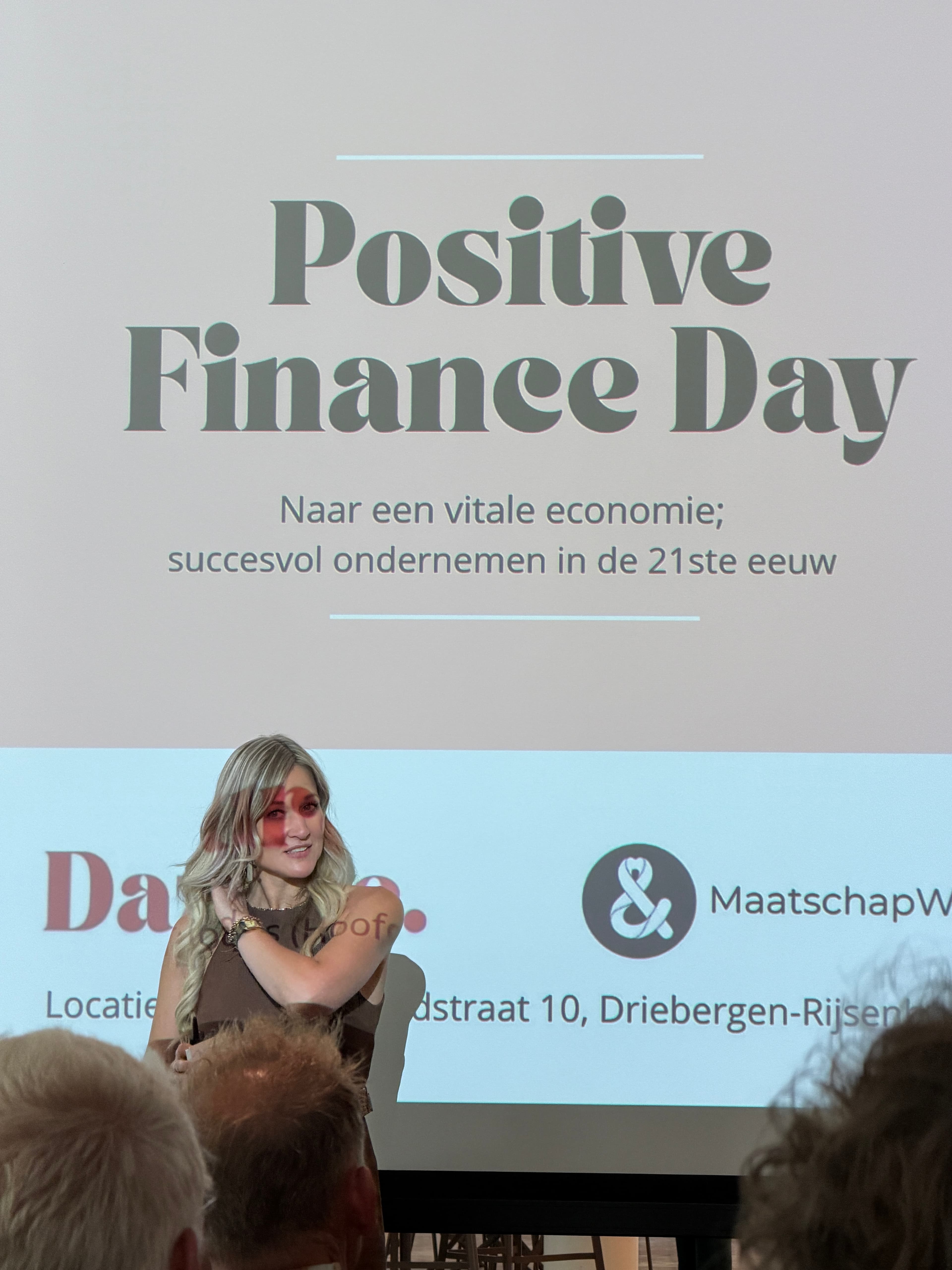
Eight editions in and it still doesn't feel like a dutiful banking conference. On Wednesday 10 June the financial sector gathered at Triodos Bank in Driebergen for the eighth Positive Finance Day. Theme: towards a vital economy. Organised by MaatschapWij with Dazure, made possible by Triodos, and driven from the very first edition by initiator Willem Vreeswijk, founder of the New Financial Forum and now active through the MaatschapWij foundation. The three of us were there: Kim Cramer, Robert Essenstam and Alexander Koene of BR-ND People.
One sentence hit home: money always does something, and almost no one asks for whom.
Money is never neutral
Hans Stegeman, chief economist at Triodos Bank, opened without preamble. Money is not a thing but a relationship. Every euro you spend, invest or lend has a counterparty; an address, a face. Almost all the digital money we use is private money, created by commercial banks the moment they extend credit. We act as if it were a neutral unit of account. It is not. It is a choice.
Then he laid bare the distinction between productive and non-productive investment. Productive: a wind farm, a factory, an education comes into being. Non-productive: a second-hand bond changes owner and nothing moves in the real world. The financial system has three jobs, handling payments, channelling capital to the right place and managing risk, and it scores a fail on all three. Sustainability risks are priced too low or pushed onto a vague 'someone else, later'.
His question to the room was uncomfortably simple: do you understand what your money does, and do you dare to ask for whom and to what effect? For a moment the room went quiet.
Heidi Leenaarts, founder of United Economy, came at it from the other side: how do you change the money system from the bottom up? Her network of more than 700 companies and 1,100 people proves that 'bottom up' need not stay a daydream.
Green growth is faith, not evidence
Then a cherished article of faith collapsed: that growth and a healthy planet go together as long as we keep getting more efficient. Science is not reassured, and honestly neither are we.
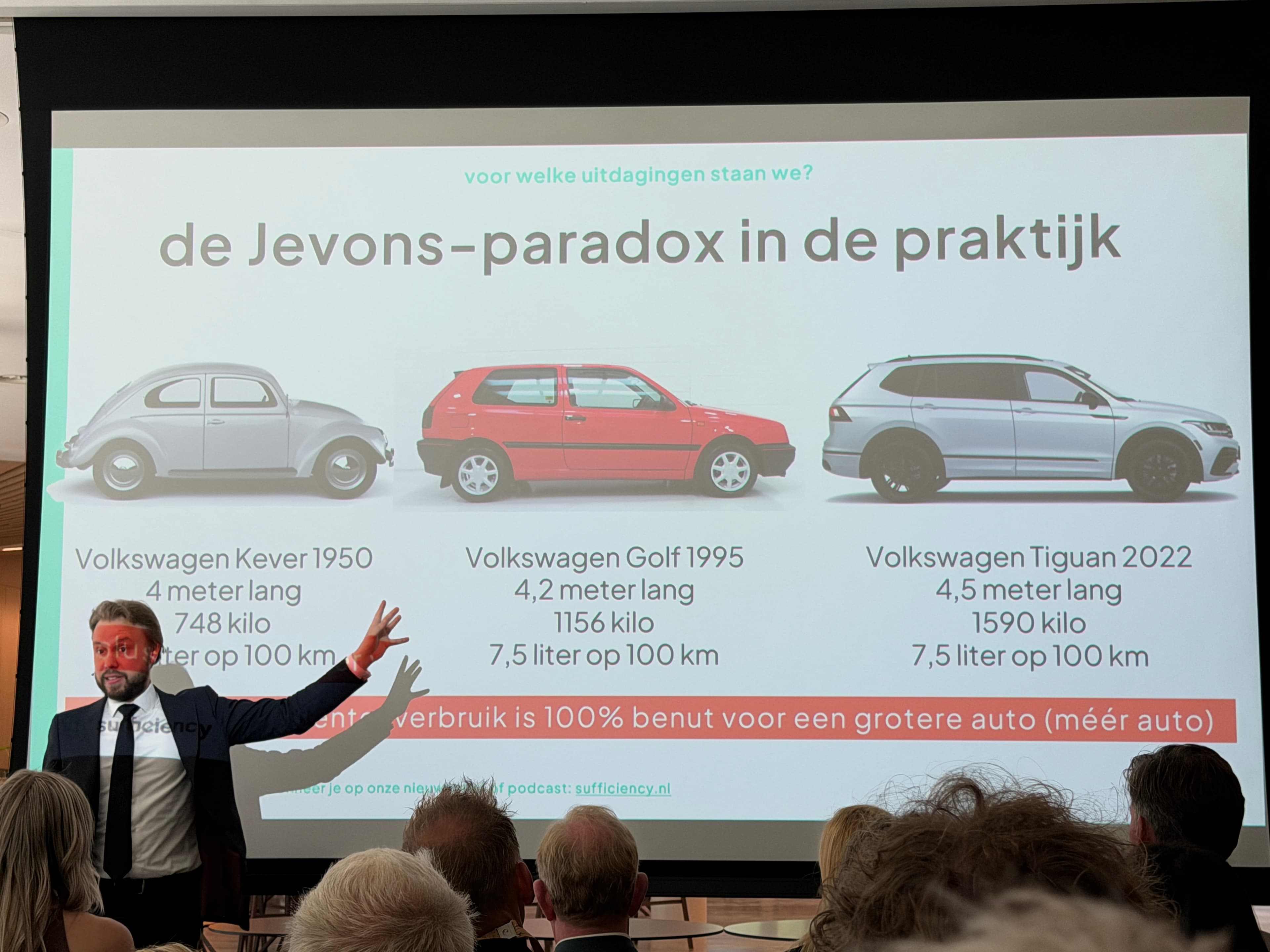
William Stanley Jevons saw it back in 1865. Make a machine more efficient and consumption goes up. Efficiency makes a service cheaper, cheaper invites more use, and the gain leaks away. Modern studies confirm that this rebound effect eats 30 to 100 percent of the environmental gain (Sorrell, 2009). One image stuck: three generations of Volkswagen, an engine that became twice as efficient, fuel use that kept hovering around 7.5 litres per 100 kilometres. The cars simply got bigger.
Economist Paul Schenderling, author of Er is leven na de groei (There is life after growth), laid a well-founded alternative beside it. He leaned on the Global Justice Report, which the World Inequality Lab under Thomas Piketty presented on 4 June: the first fully modelled route from now to 2100. The outcome is anything but dutiful.
One figure made the distance tangible. For our consumption, exports and investments, the equivalent of 13.7 million people work full time in the global south. We never see them. The solution is not charity; it is a living wage for the people who already make our stuff.
The lessons of the Global Justice Report
The core is almost sobering in its simplicity. A livable planet and high well-being for everyone can go together, on one condition: three things happen at once. Emissions fall fast. The rich world moves from overconsumption to enough, with fewer hours worked, less material and different food and land use. And inequality in income, wealth and power drops sharply, between countries and within them. It is not a menu to pick from; the three only work together.
Piketty's projection for 2100:
- Incomes in every country towards roughly 5,000 euros per person per month. The current sixteenfold gap closes.
- The poorest half's share of global wealth climbs from 2 to 30 percent; the billionaire class's share falls from 6 to 0.05 percent.
- Nearly nine in ten people double their income and work about half the current hours.
- Warming stays below 1.8 degrees, against more than 4.5 degrees under unchanged policy.
- A Global Justice Fund invests an average of 10.3 percent of global GDP per year between 2030 and 2060, paid for by a global wealth levy, a worldwide sovereign fund and a tax on the very richest. Today, less than half a percent goes to international cooperation.
The message beneath the numbers is unavoidable: on a finite planet, less inequality is what makes climate recovery possible. Here, sharing has become a matter of arithmetic.
Stories move what numbers cannot reach
MaatschapWij brought the human counterweight. Numbers explain a system; a story reaches you. Take Emily: entrepreneur, knocked over by covid, homeless with two children, and despite more than a hundred involved caseworkers barely moving forward. Not a plea for pity, but for reciprocity. Replace Emily with a refugee, with biodiversity, with the climate: the question remains whether we still see each other as a counterparty.
That is why a good story is not decoration. It is the bridge between an abstract system and people of flesh and blood.
What this means for brands, and the people behind them
This is where it touches our own work. The economy sketched here does not ask for a new slogan. It asks for different behaviour. And behaviour is exactly where a brand becomes visible.
The throughline for companies was called sufficiency: reciprocity across the chain pays off at least as much in the long run as bare efficiency. The examples were concrete. Fairphone, linking living wages to circular design. ProRail, steering on material yield. Zeeman and Lidl, shifting towards a living wage in their production. The recipe we held onto: invest the profit from your old model into your new one. Renovating while the shop stays open.
For anyone who builds brands, that is a test of behaviour rather than a campaign brief. A brand that claims to contribute to a vital economy while keeping volume growth as its only goal falls through the moment a customer or employee asks one more question. Where the line runs between genuine change and greenwashing, we set out earlier. Those who mean it change what they do first; the words follow on their own. People sense the difference between a promise and a habit without fail.
The question that lingered
The day ended with workshops and a sustainability award, but the sharpest assignment fit on one line. For whom does your money work, and what changes when your brand dares to say it out loud? Whoever has an honest answer to that need not make the rest look prettier than it is.
And most of all: thanks to Indra Frishart of Dazure, who once again made it a wonderful afternoon this year.
Questions asked by nobody!
What is the Positive Finance Day?
An annual event by the MaatschapWij foundation and Dazure, made possible by Triodos Bank, about a financial sector that works for people, society and the planet. The 2026 edition was the eighth, with 'towards a vital economy' as its theme.
What is the Global Justice Report?
A report presented on 4 June 2026 by the World Inequality Lab under Thomas Piketty. It is the first to fully model a route from now to 2100 in which a livable planet and high well-being go together, provided decarbonisation, sufficiency and less inequality happen at the same time.
What is the Jevons rebound effect?
The observation, first described by William Stanley Jevons in 1865, that efficiency gains often drive consumption up instead. A service becomes cheaper, so we use more of it. Modern studies estimate this effect can eat 30 to 100 percent of the environmental gain.
What does sufficiency mean for brands?
Steering on enough instead of always more, with reciprocity across the chain as the starting point. For a brand that is above all a test of behaviour: does your company actually change, or do you paste a green story over it?
Sources
- Positive Finance Day 2026, towards a vital economy. MaatschapWij, Dazure and Triodos Bank, 10 June 2026, Driebergen.
- Jevons, W.S. (1865), The Coal Question; Sorrell, S. (2009), Jevons' Paradox revisited, Energy Policy.
- World Inequality Lab (2026), Global Justice Report, Piketty et al.; explainer World Inequality Lab, 4 June 2026.
- Speakers: Hans Stegeman (chief economist Triodos Bank), Heidi Leenaarts (founder United Economy) and Paul Schenderling (economist, author of Er is leven na de groei).