Alexander Koene
news
14-05-2026
Article: Climate is a bad storyteller
Report from F*ck climate change?! at Pakhuis de Zwijger. Why climate communication wins on story, behaviour and hope, not on facts.
Climate is a bad storyteller
- Why doesn't the climate story land, while the facts are right?
- The four entry points that work: hope, anger, empathy, reframing
- What this means for brands in transition
Why don't climate facts work?
Fifteen thousand scientists signed a second warning to humanity in 2017. Mare de Wit read it and felt nothing. That is not indifference, that is the diagnosis. She wrote an opinion piece about it in Het Parool in October 2024, titled How would I sell climate change? It became a book. And last night it became a packed room at Pakhuis de Zwijger.
The title of the evening: F*ck climate change?! The tone of the evening: surprisingly warm, surprisingly practical, surprisingly awkward in exactly the places where that fits. No finale, but an arena. Four speakers with four stories, a behavioural strategist who pulled it all together, and the quiet headline question: why does the story not land, while the facts are right?
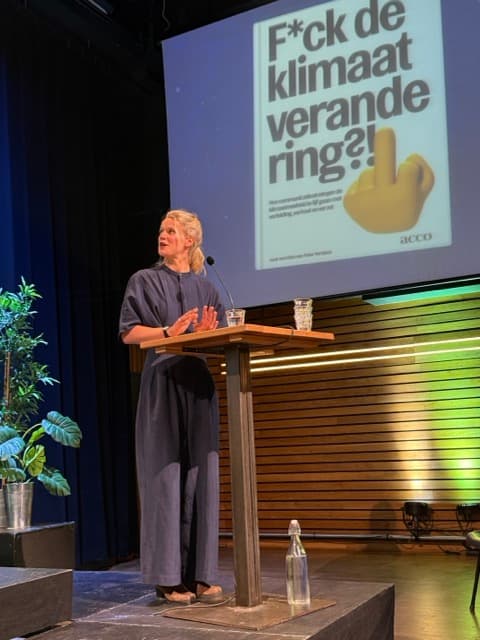
Why is climate a bad storyteller?
Bart van den Hurk, co-chair of IPCC working group 2, said it in a single line: climate is a bad storyteller. It has no goal, no opinion, no side. Reports are full of facts and empty of character. And stories without character do not land.
That diagnosis is not a small detail. The IPCC has now added communications people as authors on the team. Not to make the science prettier, but to put dilemmas, perspectives and values next to the numbers. Who wins, who loses, who chooses, who pays. That is where stories start.
Which four climate stories actually work?
Peter Verbiest, initiator and editor of the book, deliberately picked ten stories instead of one. People are not one audience, so there is no single message that works. He used the Fosbury Flop metaphor: the high jump only went higher once someone went over the bar backwards. We do not need one better climate story, we need a different technique.
Four pitches stood out.
Evert Van den Broeck - the silent majority
He focuses on people who care about climate but only move when there is something in it for them. His approach in three steps: show what people already do, thank them for it, then ask for a small next step. No moral appeal, but a build-up.
Isabelle Cannoo - hope as strategy
She chose hope. Not as reality, but as strategy. She spoke about her daughters of 5 and 2 and about the paralysis of who am I in the bigger picture? Her answer: if enough people do small things that inspire others, something tips. Hope is then not a feeling, it is a method.
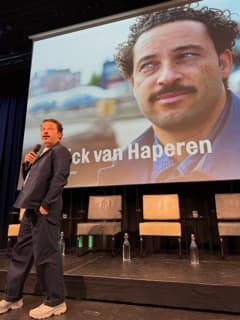
Patrick van Haperen - anger as fuel
He went the other way. Tuvalu is going under. The shark is coming for everyone. Do not ask people if climate matters to them, ask if they will stand for this. Anger and injustice are fuel, as long as they go somewhere.
Tallita Ortiz de la Torre - empathy as starting point
She argued for the indifference frame: looking at people empathically, in their own situation. Someone with little financial, cultural or social capital has less room for big steps. That is not an excuse, it is a starting point. Help without judgement, also your neighbour.
One of the authors added the visuals. Cyberpunk shows how it goes wrong. Solarpunk shows how it can also go: technology, nature and social equality in one frame. Images do not only tell us who we are, they show us who we could be.
What does behavioural science say about climate communication?
Tom De Bruyne, of SUE & The Alchemists and behavioural strategist, threw a few stones through the glass walls of climate communication at the end of the evening.
One. The difference between being right and being heard. Whoever keeps hammering on moral high ground mostly becomes insufferable. Outrage as a hobby, he called it blood pornography. It feels active, it changes nothing.
Two. Change the question. Not stop flying, but a fantastic hiking holiday with your kid. Not go vegan, but Middle Eastern street food you will not want to miss again. Do not ask people to sacrifice, inspire them with something better.
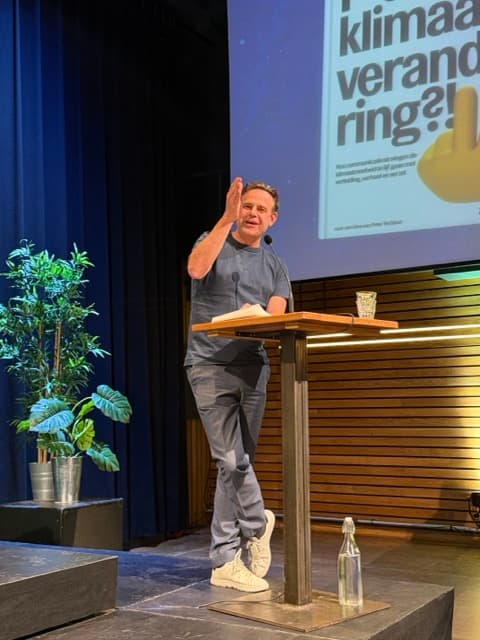
Three. Reframe fossil. Fossil energy is not only the villain, it is also the source of the prosperity we know. Olaf van der Gaag calls the alternative orange energy: from our own soil, no longer up for blackmail by Qatar or Russia. Same story, different frame, different voter picks it up.
Four. Get your hands dirty. Marianne Minnesma of Urgenda sees herself as an entrepreneur, not as an activist. A Frisian farmer became a director at Rabobank Investmentbank. A nature organisation supplies the chair of the sustainable energy association. The most effective people in this movement put their reputation on the line by sitting down at the opponent's table. Not to water down the wine, but to get the wine on the table.
Five. Make it enjoyable. A group of farmers switched to herb-rich grassland the moment a collective purchase made it as cheap as industrial grass. Not by conviction, but by addition. As Tom closed the evening, paraphrasing a quote about socialism: the climate transition will be enjoyable, or it will never happen.
What does this mean for brands?
For anyone who builds brands, the whole evening was full of usable material. Three observations.
A brand without character is a report. A lot of sustainability communication reads like an IPCC annex: facts, percentages, promises. No character, no dilemma, no choice. Then it does not land. Not with the customer, not with the employee.
Co-benefits beat mission. Tesla did not get big because people wanted to save the climate. It got big because the car was better, faster and cooler, and the climate story rode along. Trojan horse, Tom called it. For brands in transition: stop treating the climate page as a separate silo, build it into the proposition itself.
Audiences are not audiences, they are entry points. Activist, pragmatist, doubter, sceptic, believer, parent of young children, farmer with land: each asks for a different story, with a different hero and a different benefit. One message for everyone is usually one message for no one.
Invitation
The evening ended without a conclusion and that was right. No winner from four pitches, but four ingredients next to each other. Hope keeps people in, anger gets them moving, empathy lets them start, and small next steps make it sustainable. Humour was missed and was meanwhile present in the room.
The question we walked home with is the same question we would put to every brand team tomorrow: what behaviour do you want people to choose differently because of this, and what story makes that more attractive than the alternative?
Whoever has an answer to that does not need to shout.
Read also: Why the climate crisis is a marketing problem.
Sources
- De Wit, M. (2024, October). How would I sell climate change? Het Parool.
- Verbiest, P. (ed.) (2025). F\ck de klimaatverandering?! Hoe communicatiestrategen de klimaatmoeheid te lijf gaan met verleiding, verhaal en verzet.* Leuven: Acco Uitgeverij, 165 p., ISBN 9789464678291. With contributions by Isabelle Cannoo, Tom De Bruyne, Eline Goethals, Tom Himpe, Tallita Ortiz de la Torre, Vincent Jansen, Hamza Ouamari, Evert Van den Broeck, Patrick van Haperen and Peter Verbiest.
- IPCC AR6, Working Group 2 (Bart van den Hurk et al.).