Alexander Koene & Kim Cramer
news
26-06-2026
Article: Cannes Lions 2026: own the beach, steal the show
At Cannes Lions 2026 the tech giants own the beach and the attention. What that means for brands, people and the creative craft; with sources and figures.
Cannes Lions 2026: own the beach, steal the show
Last week Kim and I walked a Croisette that no longer belonged to the ad agencies. The big tech players owned the boulevard: Amazon built a harbour, Microsoft a garden, Reddit a delicatessen, and Google, OpenAI and Salesforce filled the stages. TikTok drew the longest queue anyone could remember. Put up a harbour, a garden and a deli just to sell software and you are clearly not working on a tight budget. The familiar agencies still won the Lions; Ogilvy took Network of the Year, LePub took Agency of the Year, and Heineken was named Creative Brand of the Year. But they no longer set the scene on the street.
Own the beach, own the attention. That is not a footnote; it is a shift in power. Power is moving from the people who make the message to the people who decide whether, where and to whom it appears. Agencies still deliver the creative work, but the tech companies own the audience, the data and the rules of distribution. Whoever controls attention and access controls the value in the end.
Amsterdam Impact aboard the Stad Amsterdam
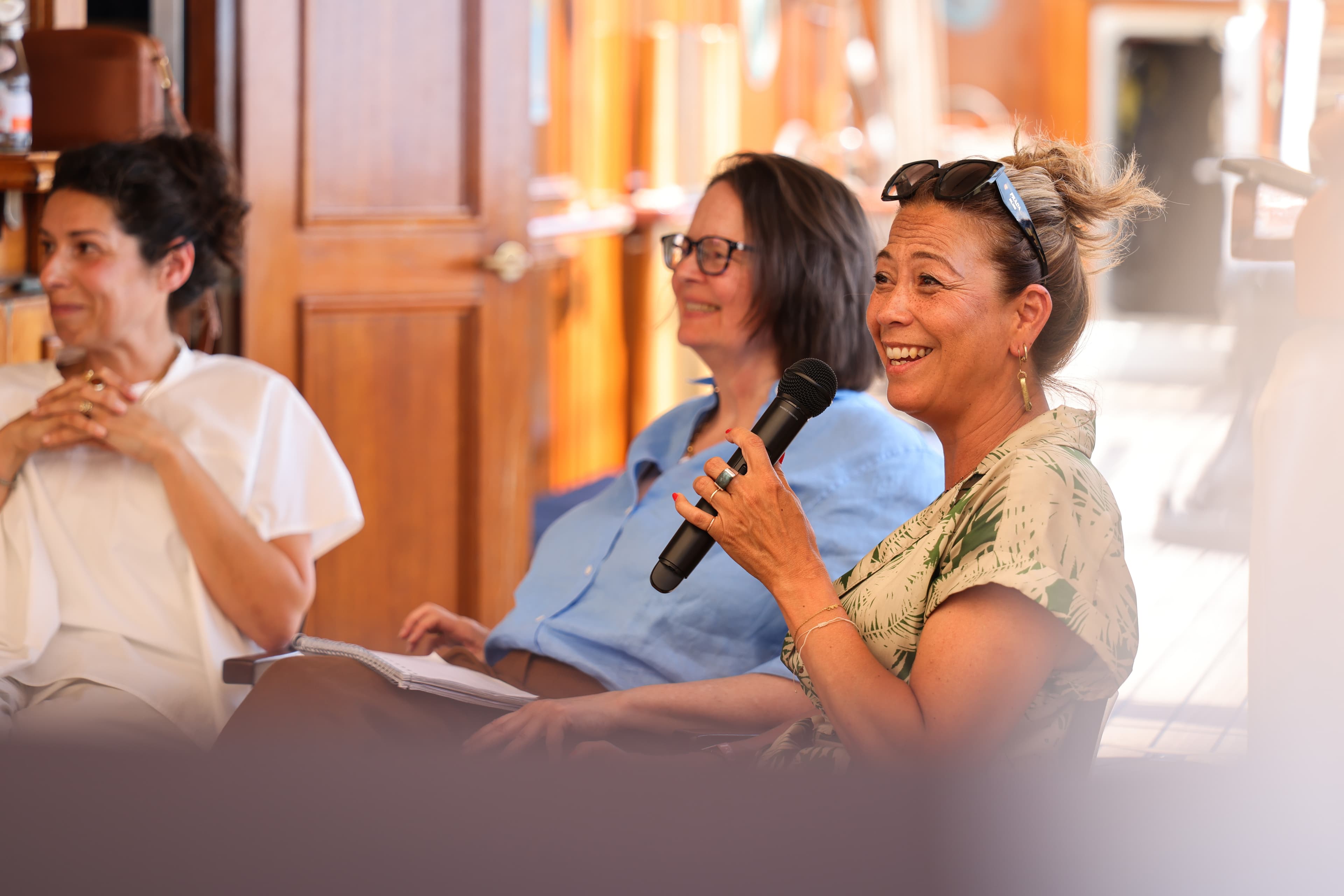
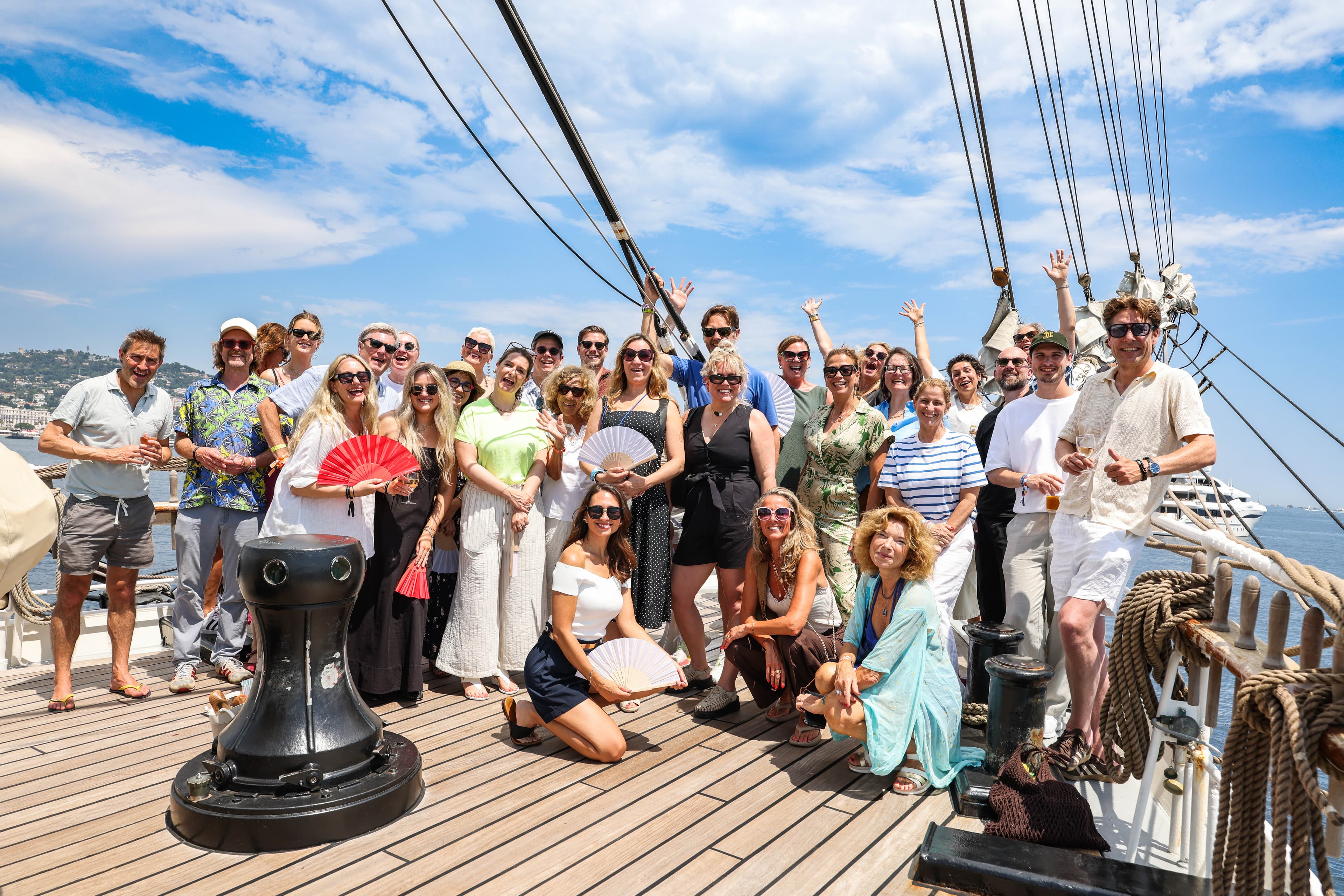
We were there from Monday to Wednesday evening, and spent a full day aboard the clipper Stad Amsterdam. Together with Amsterdam Impact, we launched the Impact Frontrunners initiative and the three scenarios we are working on. Kim led a panel with Ellen from Amsterdam Impact and with Judith, managing director of Havas Lemz, on sustainability and on the question of what the creative craft still adds now that so much production is sliding towards the machine. A ship makes for a grateful audience too: no one can slip away halfway through. On the water, with people sitting in a circle, the contrast with the beach clubs was sharp; real attention cannot be hijacked, it has to be earned. We made several new connections on the spot, from agencies to media companies in cinema and outdoor, all keen to join Impact Frontrunners.
The irony was lying in the street, literally. The sheer number of cars kept central Cannes in a permanent traffic jam. For a craft that loves to award itself for sustainability and a liveable society, that grates. The jury rewarded green campaigns; the street rewarded exhaust fumes. High time for a car ban in the city, the kind we now see in more and more places worth living in.
On Monday we were also guests at a session by The Female Quotient (FQ) on women's leadership. FQ, founded by Shelley Zalis, is a community and advisory organisation working towards equal opportunity for women at work; at Cannes it gathers those conversations at its FQ Beach on the Croisette. We watched women at the top keep valuing their own humanity and put it to work; warmth became a form of leadership there, a way to help people grow without burning them out. Exactly the behaviour that makes a brand credible from the inside out.
And the highlight? The Young Dogs dance party into the small hours. The Oranje borrel, sponsored by Adformatie and Jean Mineur, was a joy too; we met so many Dutch people in Cannes who all live within a 15km circle of Amsterdam. A good reminder that this craft is also simply about people and fun.
What others noticed, and not the hallelujah
We had our own impressions, but what colleagues noted critically this year is more interesting. A selection, with sources.
AI everywhere, little wow. Marketing Dive spoke to several attendees and kept hearing the same complaint: plenty of tech presence, little technological surprise. "You know the technology is much further along than what's shown here on the beach," said Rebecca Sykes of The Brandtech Group. Angela Tangas, global CEO of Oliver, was blunter: the whole sector is in an arms race to show value, "and that value is about efficiency gains, not real business outcomes." A client lead at BBDO summed it up: you notice you are five steps ahead of the conversation happening on stage.
The harder question: did it actually work? Last year AI was the new toy. This year a more uncomfortable question was on the table. Erin McCallion of Perion, quoted by Brand Innovators: "Did it actually work?" The new Creative Brand Lion and the Effectiveness track with WARC push makers to prove that an idea grows a brand. Not everyone has that proof, wrote Alex Turtschan of Mediaplus.
AI has moved from innovation story to revenue model. Analysis firm CARMA noted, via PRovoke Media, that the coverage was no longer about the promise of AI but about the money. OpenAI used Cannes to recruit advertisers for ads inside ChatGPT, which now has around 900 million weekly users and where roughly one in five queries is already commercial in nature (Forbes). ChatGPT no longer behaves like a product; it behaves like a media channel. The assistant that writes your copy now wants to sell your ad space too.
The trophy cabinet did not always hold up. After the scandal year of 2025, with AI-faked cases and revoked trophies, Cannes brought in new integrity rules: human and machine fact-checking, stricter client sign-off and suspensions of up to three years for fake work (Adweek). DeSmog showed how sustainability claims in previously awarded campaigns fell apart under scrutiny. Looking good with a nice number is easy; making it true is the real work.
The internet is splitting in two. Turtschan put it well: an internet is forming for people who still scroll, read and sometimes click, and an internet for machines that take that reading over. If an AI assistant condenses a thousand sources into a single answer and makes the choice before any brand interaction happens, where does your message still fit? His answer came close to what we felt on the water: no AI agent reads the poster at the bus stop for you, and no summary stands between you and a pop-up in the city. The physical world becomes the last place where people discover a brand without a machine in between. That is why the return to real life, concerts, events, encounters, is the real trend of the year.
The creators were everywhere. The influencers, now called creators, were kept entertained with content to blog and videocast about. Nothing new about influencers; what changed is their place. Marketing Dive: creator spending in the US is heading towards 44 billion dollars this year. It has become a fixed channel rather than a fringe phenomenon.
And the absence we noticed has a price. After a year of heavy layoffs at the agencies, the picture of executives being waited on at the Côte d'Azur grates (Marketing Dive). Juniors are getting too expensive to bring along; the very people who still need to learn the craft are left standing outside.
In a panel on AI, creativity and inclusion we heard how production house Monks went from around 9,000 to 6,000 people in three years, and how the exact same job posting with the word "AI" in the title drew 80% fewer female applicants. The technology changes faster than the culture around it. That is where the work lies.
What Cannes Lions 2026 means for brands and people
The mass media of old are giving way to personalised experiences in real life, which are then pumped around digitally to harvest attention. The opportunity and the discomfort sit in the same move. The opportunity: encounters where people feel a brand, not just see it. The discomfort: the moment that experience hits social, it becomes ammunition in an attention battle that is rarely about the person.
For us, Cannes 2026 confirms one thing. When machines decide what people get to see, the behaviour of the people behind a brand becomes the last distinction that cannot be copied. A brand built clearly around the people who carry it stays readable for a human and for an AI hunting for a trustworthy answer. So test every choice against behaviour: what will people feel, say, choose or do differently because of this?
The question we took home
The most interesting question in Cannes this year was not about which campaign won. It was about what becomes of the craft itself. We picked our side on the water: build for the human, and let the technology carry the work, not the meaning. The rest is noise with a tidy row of figures underneath.
Sources
- Marketing Dive, "5 Cannes Lions takeaways as marketers wrestle with an industry in flux" (2026): https://www.marketingdive.com/news/5-cannes-lions-takeaways-as-marketers-wrestle-with-an-industry-in-flux/823850/
- Alex Turtschan / Mediaplus, House of Communication, "Cannes Lions 2026: A Week Full of Questions" (2026): https://www.house-of-communication.com/int/en/newsroom/blog/2026/06/mediaplus-alex-turtschan-cannes-lions-article-one.html
- PRovoke Media / CARMA, "Cannes Lions 2026: Data Shows That CEOs And Culture Are Rewriting the Festival Narrative" (2026): https://www.provokemedia.com/latest/article/cannes-lions-2026-data-shows-that-ceos-and-culture-are-rewriting-the-festival-narrative
- Adweek, "Agencies Say New Cannes Lions Entry Rules Are 'Burdensome,' But Necessary" (2026): https://www.adweek.com/agencies/agencies-say-new-cannes-lions-entry-rules-are-burdensome-but-necessary/
- DeSmog, "The 'Oscars of Advertising' Has a Cheating Problem" (2026): https://www.desmog.com/2026/06/19/the-oscars-of-advertising-has-a-cheating-problem/
- Brand Innovators, "What industry insiders expect at Cannes Lions 2026" (2026): https://brand-innovators.com/what-to-expect-at-cannes-lions-2026/
- Business Insider, "Creativity strikes back at the Cannes Lions advertising festival" (2026): https://www.businessinsider.com/cannes-lions-recap-creativity-ai-creators-2026-6